






News
35 Year Pvd Coating Machine In Foxin
From Traditional Surface Finishing to PVD: How a Bathroom Hardware Manufacturer Upgraded Its Coating Process
Overview
Surface finishing is critical to both the appearance and performance of bathroom hardware. For years, traditional electroplating dominated the industry, but it carries heavy environmental burdens, offers limited wear resistance, and struggles to maintain consistent colour from batch to batch. As European and American markets raise the bar on environmental compliance, quality, and lead times, PVD coating for faucets and sanitary ware has gained rapid traction — and moving PVD coating for bathroom hardware in-house has shifted from a technical experiment to a production decision. With its dense films, high wear resistance, stable colour, and eco-friendly process, PVD (physical vapor deposition) is steadily replacing conventional electroplating and spray-paint finishes. Looking ahead, as equipment efficiency improves and energy consumption drops, vacuum coating will only become more promising across bathroom and home hardware applications.
Project at a Glance
| Item | Detail |
|---|---|
| Customer | A mid-sized bathroom hardware manufacturer in Guangdong, China |
| Industry | Bathroom hardware and sanitary accessories |
| Substrate | 304 stainless steel |
| Main markets | Europe and the United States |
| Previous finishing | Spray painting and baking enamel, colour work outsourced |
| New equipment | Mid-frequency magnetron multi-functional PVD vacuum coating machine |
| Equipment size | 1800 × 2000 mm |
| Key configuration | Mid-frequency magnetron sputtering system, mid-frequency power supply, molecular pump power supply, vacuum pump set |
| Project cycle | About 2 months from first contact to signed order |
| Status at publication | In production for close to one month |
Who the Client Is
The client is a mid-sized bathroom hardware manufacturer based in Guangdong, China. Their products are mainly sold to European and American markets.
Previously, they outsourced part of their colour finishing. As quality and delivery requirements tightened, they decided to bring PVD surface treatment in-house rather than continue buying colour work from outside suppliers.
The Finishing Problem: Spray Paint, Baking Enamel and Outsourced Colour Work
Their products are primarily 304 stainless steel and require surface treatment to achieve different colours. They previously relied on spray painting and baking enamel, completed by outside processors.
These conventional finishes lack wear resistance and can chip or expose the substrate over time. The client wanted a more reliable PVD solution.
There was also a control problem. Products were manufactured first, then sent out to a finishing shop for colour treatment. Because surface finishing happened outside their own facility, the client had little direct control over the process, quality, or scheduling. With in-house PVD equipment, they can now handle PVD finishing on-site — moving from outsourced processing to independent production.
Two Pain Points That Forced the Change
Two core issues stood out.
Inconsistent Quality
Colour varied from batch to batch, making quality management difficult.
Unpredictable Lead Times
Outsourced processing depended on the supplier’s schedule, with typical delays of 10 to 15 days per batch — and up to one or two months in the worst cases.
Traditional spray painting and baking enamel also brought wear-resistance and environmental compliance challenges, which is the same pressure driving manufacturers to replace electroplating with PVD across the sanitary ware sector.
Why They Chose FOXIN
While working with their original outsourcing partner, the client noticed that several finishing shops were already running FOXIN PVD equipment — giving them direct exposure to how it performs in real production.
We then connected offline, and the client visited our facility to discuss equipment options and their actual needs face to face. In the end, they chose us because our production management is disciplined, our process and quality control are strict, and our equipment is built with solid materials and craftsmanship.
It matched their in-house production requirements, and our long-standing reputation in the PVD equipment industry gave them confidence that we could help improve both quality and delivery control.
The Equipment: A 1800 × 2000 mm Mid-Frequency Magnetron PVD Machine
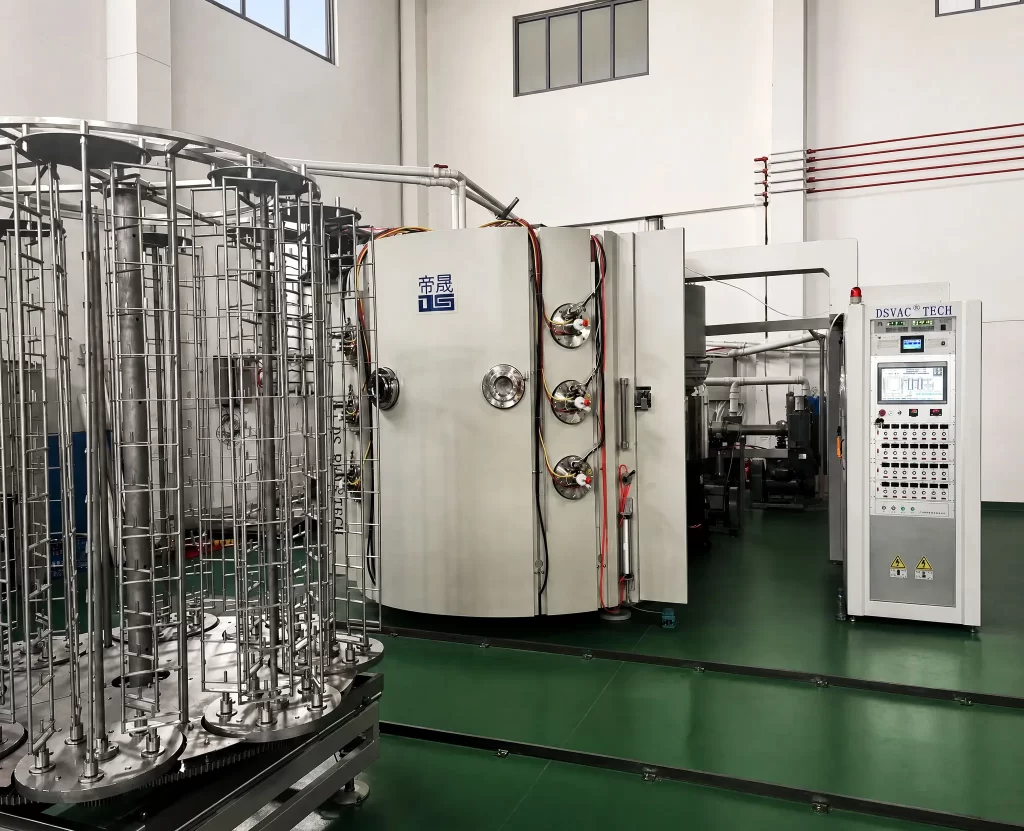
They purchased a mid-frequency magnetron multi-functional PVD vacuum coating machine, sized 1800 × 2000 mm, mainly for PVD colour finishing on bathroom hardware.
The machine is a magnetron sputtering machine built around a mid-frequency magnetron sputtering system, which is what makes dense, uniform decorative films possible on stainless steel hardware.
Key Configurations
- Mid-frequency magnetron sputtering system
- Mid-frequency power supply
- Molecular pump power supply
- Vacuum pump set
The client prioritized start-up efficiency, energy consumption, coating quality, and equipment stability — so they chose the molecular pump configuration to improve uptime and production stability.
From first contact to final deal, the project took about two months.
What Changed After the Machine Went Into Production
The equipment has been running for nearly a month. The most obvious improvements are in quality and delivery.
Batch Colour and Product Consistency
Batch-to-batch colour variation has been reduced and product consistency has improved.
Lead Times Back Under Their Own Control
Previously, outsourced processing averaged 10 to 15 days of delay per batch. Now the client handles PVD colour finishing in-house, schedules production independently, and delivers on time.
Yield
The client reports yield is about 10% higher than with outsourced processing.
Installation, Commissioning and After-Sales
During installation and commissioning, the client was satisfied with the on-site work overall. After the equipment went into production, our after-sales team responded promptly whenever issues came up, and the client is satisfied with the service.
The equipment has mainly solved two core problems: difficult quality control and unstable lead times from outsourcing. On-site installation photos can be used for future case studies, but the client’s company name will not be disclosed.
Project Summary
A mid-sized bathroom hardware manufacturer in Guangdong, focused on 304 stainless steel products, previously relied on spray painting, baking enamel, and outsourced processing for colour finishing.
After adopting a mid-frequency magnetron PVD vacuum coating machine, they brought colour finishing in-house, improved batch colour consistency and quality control, and shifted delivery scheduling from supplier-controlled to self-managed. Reported yield improved by about 10% compared to outsourced processing, and the previous 10 to 15 day average delay per batch was resolved.
For bathroom hardware makers selling into Europe and the US, the deciding factors are not just film hardness on paper — they are whether colour holds batch after batch, and whether the delivery date belongs to you or to your supplier.
Related Equipment and Articles
- PVD coating machines — compare multi-arc, magnetron sputtering and large-diameter models by chamber size, film options and output per batch
- Bathroom PVD coating machine — how bathroom hardware colour finishing is configured for volume production
Get a PVD Coating Solution for Bathroom Hardware
Are you a bathroom hardware manufacturer looking to move colour finishing in-house?
FOXIN can develop a PVD coating system according to your part dimensions, target output, available factory space and required surface effect. Send your sample and we will coat it in our own plant before you commit to a line.
FAQ
1. Why would a bathroom hardware manufacturer move PVD coating in-house?
Two reasons usually drive the decision: colour consistency across batches, and control over delivery dates. When finishing is outsourced, both depend on an outside supplier’s schedule and process discipline.
2. What equipment was used in this project?
A mid-frequency magnetron multi-functional PVD vacuum coating machine, sized 1800 × 2000 mm, configured with a mid-frequency magnetron sputtering system, mid-frequency power supply, molecular pump power supply and vacuum pump set.
3. Why choose a molecular pump configuration?
The customer prioritised start-up efficiency, energy consumption, coating quality and equipment stability. The molecular pump configuration improves uptime and keeps production stable once the machine is in daily use.
4. How long does a project like this take?
From first contact to signed order, this project took about two months. Machine delivery and installation follow the agreed production schedule.
5. Can the same approach be used for faucets, taps and other bathroom fittings?
Yes. Mid-frequency magnetron PVD is used on stainless steel bathroom hardware where decorative colour and corrosion resistance are both required. Film selection and fixture design are matched to the part shape.