






Gold Plated vs Solid Gold: What Each Label Means and How Long It Lasts
Short answer
Gold plated jewelry does contain real gold, but usually well under 0.5 microns of it, and it sits on top of a cheaper base metal. Solid gold is the same alloy all the way through, so there is no layer to wear off. Between them sit gold filled and vermeil, which are legally defined and considerably more durable than plating.
Introduction
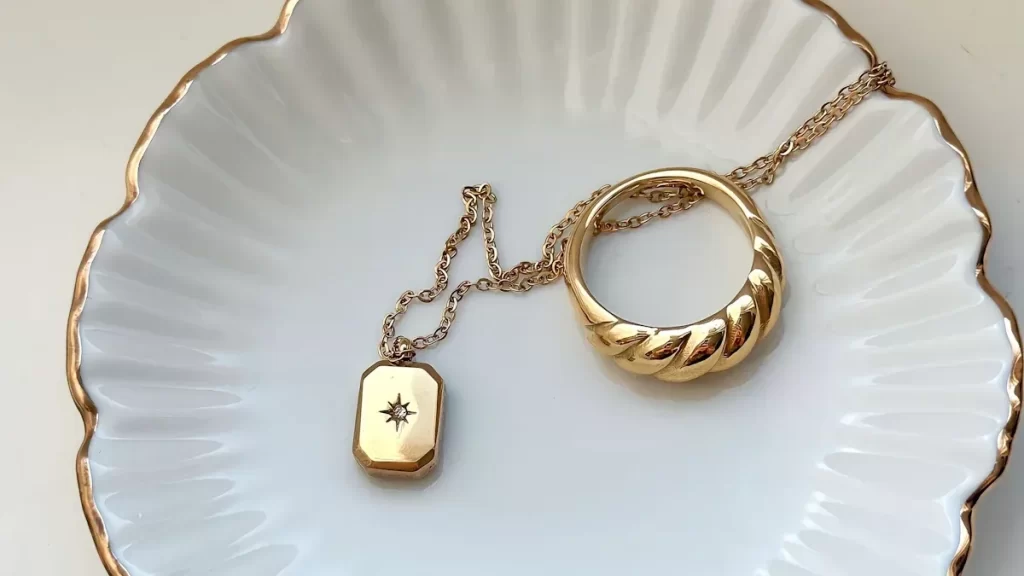
Two gold necklaces can hang side by side in the same display case, both the same warm color, both within a few dollars of each other. One still looks new in ten years. The other shows bare base metal in six months.
Whether a piece is gold plated, gold filled, vermeil or solid gold decides that outcome long before wear does. The label answers two questions a karat stamp does not: how much gold is actually there, and what happens when it wears through. That second question generates the returns, and it is the one most listings never answer. The same logic applies to finished gold coated parts across our PVD coating for jewelry work, where substrate and coating are chosen together.
What does “gold plated” actually mean?
Gold plated means a microscopically thin layer of gold was deposited onto a base metal by electroplating, and it is the least durable of the four gold constructions.
The mechanism is electrochemical. The base piece is submerged in a solution of dissolved gold ions, a current is applied, and gold deposits onto the surface. The layer is measured in microns, one millionth of a meter. A typical flash-plated fashion piece carries around 0.175 microns, roughly 400 times thinner than a human hair.
Three consequences follow directly from that thickness:
- The base metal matters as much as the gold. Brass, copper and nickel alloy are the usual cores. Once the gold wears through, the core is what touches skin and air.
- The karat number on the label describes a film, not the piece. “18K gold plated” tells you the purity of a layer you could scratch through with a fingernail. It says nothing about the body of the item.
- Color does not predict quality. A gold plated piece and a gold filled piece can be visually identical. Only the construction label separates them.
The four tiers of gold jewelry, side by side
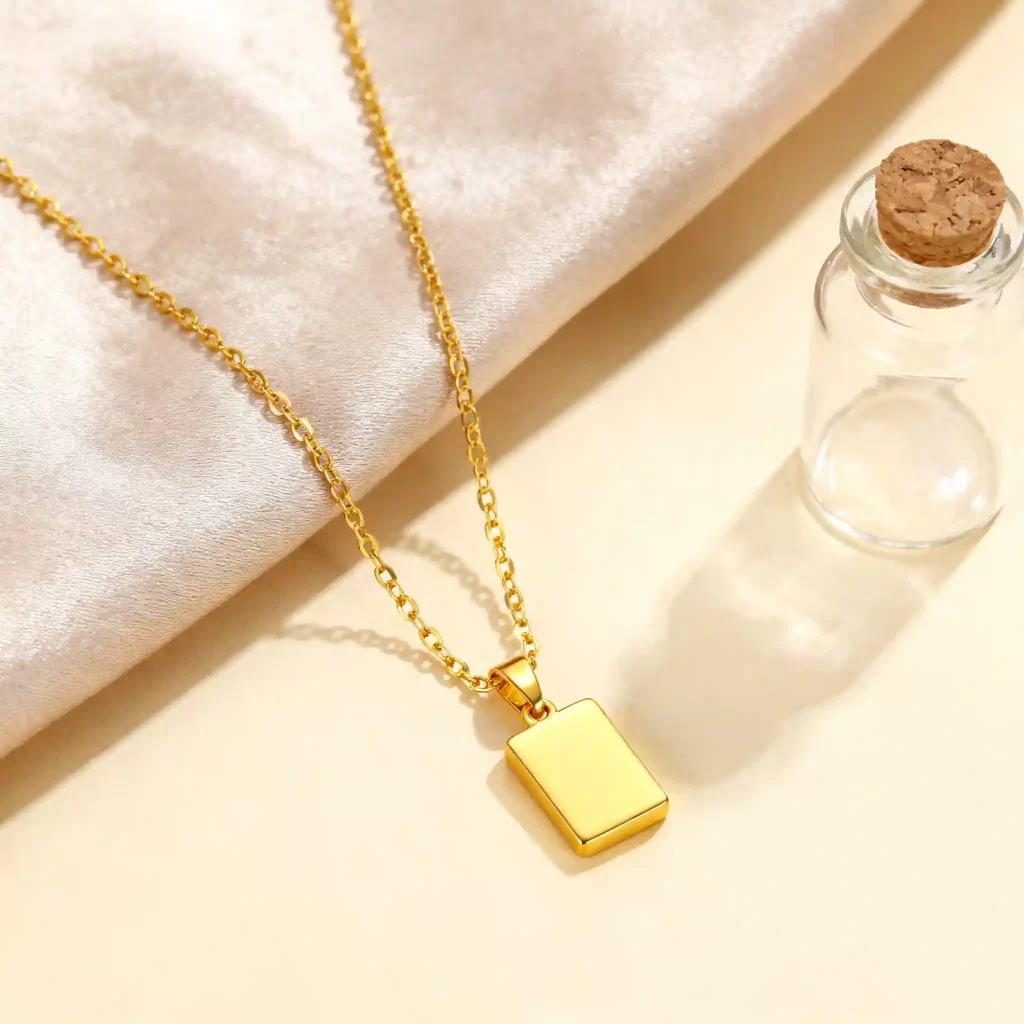
Four labels describe how gold is put onto a piece, and each one has a different amount of gold, a different wear life and a different resale reality.
| Construction | What it actually is | Typical gold layer | Realistic wear life | Common stamps |
|---|---|---|---|---|
| Solid gold | Karat alloy throughout, no coating | None needed — gold through the cross-section | Decades, and repairable | 10K, 14K, 18K, 22K, or 417 / 585 / 750 / 916 |
| Gold filled | Layer of 10K or finer gold mechanically bonded to a brass core under heat and pressure | At least 1/20 (5%) of total weight, often 40–100+ microns | Commonly 10 to 30 years | GF, 14K GF, 1/20 12K GF |
| Vermeil | Defined thickness of 10K or finer gold over a sterling silver base | Minimum 2.5 microns | Roughly 1 to 3 years of daily wear | 925 plus “vermeil” |
| Gold plated / electroplate | Thin electrolytic deposit of gold over any base metal | 0.175 to about 2.5 microns | Six months to about 2 years on worn pieces | GP, GEP, HGE, EP |
Two facts sit at the center of this table. First, plating carries well under 0.1% actual gold by weight, while gold filled typically carries 2% to 5% as fine gold. That is an order of magnitude, not a rounding difference. Second, the karat number on a coating matters far less than its thickness: a 14K plated chain can hold less gold than a 10K gold filled chain.
The two middle tiers are the ones buyers misjudge. Vermeil is often assumed to sit near solid gold, and it does not — the gold is genuinely thin, and most of the value is the sterling silver underneath. Gold filled is the reverse case: frequently dismissed as “just plating”, when its wear life is closer to solid gold than to plating.
What US labeling rules require — and what they do not
The most useful thing to know about the word “gold plated” is that it has no federally mandated minimum thickness in the United States.
Under the Federal Trade Commission’s Guides for the Jewelry, Precious Metals, and Pewter Industries, codified at 16 CFR Part 23, three of the four labels above carry numeric definitions:
- Gold electroplate requires gold of 10 karat or finer, minimum 0.175 microns overall.
- Heavy gold electroplate raises that to 2.5 microns.
- Gold filled requires a mechanically bonded layer of at least 10 karat gold, equal to at least 1/20 of total metal weight.
- Vermeil requires all three: a sterling silver (925) base, gold of 10 karat or finer, and 2.5 microns minimum.
- Plain “gold plated” has no such floor.
That last line is the one to remember. A seller can call a piece gold plated whether the layer is 0.05 microns or 3 microns. The label describes method, not quality.
Two practical rules follow. Look for the karat to precede the term, as in “14K gold plated”. And treat terms such as gold tone, gold color and gold washed as what they are: color descriptions with no gold content claim. A piece labeled gold tone may contain no gold at all.
How long does gold plated jewelry last?
Gold plated jewelry typically lasts six months to two years with regular wear, and the variables that decide which end of that range you land on are thickness and base metal, not karat.
Thickness is the obvious one. A 0.175 micron flash plate over brass is a season of occasional wear. A heavy electroplate at 2.5 microns over stainless steel can hold two years of daily use.
Base metal is the less obvious variable, and it explains most “the gold came off” complaints. On a brass core, moisture and sweat reach the base through micro-pores in the deposit. The brass corrodes, corrosion products migrate to the surface, and the piece discolors. The gold did not wear away — the metal underneath reacted, and the customer is usually looking at brass corrosion rather than exposed brass.
Where the failure happens matters too. Wear concentrates at contact points and fails there long before it fails on the visible face:
- Jewelry: the clasp, the jump ring, the inside of a ring shank, the earring post.
- Watches: the case edge, the crown recess, the underside of the bracelet links.
- Buckles and hardware: the prong tip, the hinge contact face, anywhere two gold surfaces rub.
When you assess a sample, those are the places to inspect under magnification. A bright top face tells you almost nothing.
Why gold plated stainless steel behaves differently
Stainless steel changes the failure mode, because the base metal carries its own corrosion protection.
The alloy contains around 10% to 12% chromium, which forms a passive oxide layer the moment the surface meets air. That layer stops rust, and it also stops anything else from bonding — which is why stainless steel is the hardest common substrate to plate. Electroplating it requires ultrasonic cleaning, an acid dip to strip the oxide, and a nickel strike to give the gold something to grip before the oxide re-forms. Each of those stages is set out in gold plating on stainless steel, step by step.
Two things follow. When a scratch breaks through the gold on a stainless part, the metal underneath is still stainless steel. It does not corrode, does not leave a green mark, and does not turn the piece unwearable — it looks scratched instead of ruined.
The complication is the nickel strike. Nickel is the most common contact allergen, and in some markets skin-contact items must meet a nickel release limit — in the European Union, 0.5 micrograms per square centimeter per week. A plated piece can pass when new and fail once wear opens the pores and exposes the nickel. Whether a vacuum-deposited finish avoids that problem entirely is covered in whether PVD coatings are safe for everyday skin contact.
How a vacuum-deposited gold coating wears differently
A gold coating applied in a vacuum chamber removes the porous layer entirely, which is why it outlasts the same nominal thickness of electroplated gold.
The mechanism is different in kind. Instead of depositing gold ions from a bath, the process vaporizes metal in a chamber pumped to 10⁻¹ to 10⁻⁵ Pa, ionizes it, and drives it into the surface. A chromium or chromium nitride layer goes down first to carry adhesion, then the gold-bearing topcoat. In many decorative builds the gold color comes from a titanium nitride based film rather than pure gold, which is why the film is so hard — commonly 2,000 to 4,000 HV, against roughly 200 to 400 HV for electroplated gold. That process runs on the vacuum coating systems we build for jewelry and watch parts.
What that buys in practice:
- No pores. Moisture cannot reach an underlayer, because there is no continuous underlayer to reach. Nickel release stops being a design risk when the substrate is 316L stainless steel.
- Harder than the gold itself. Abrasion from skin, fabric and other metal has far less effect, so the coating wears at the surface rather than through it.
- Color that holds across a batch. Vacuum deposition is uniform, so two pieces from the same recipe match.
- No liquid effluent. The dry process matters for brands selling into markets with plating waste restrictions, though the capital cost is higher — see what a vacuum coating line costs.
The two constructions are compared in detail in our article on the difference between gold plating and PVD gold plating. The short version: plating is a layer on a surface, PVD is a film bonded into a surface, and the difference shows up in year two of wear, not week one. The equipment behind it is the multi-arc ion plating machines used for decorative gold tones at volume.
Signs a gold coating is wearing through
Wear announces itself in a predictable order, which makes it diagnosable before a customer complains.
- Dulling before discoloration. The finish loses its bloom first. Gold that looks flat under light is usually thinning.
- Color shift at edges and contact points. Watch the prong tips, ring shanks and clasp edges. A different color there means the layer has begun to go.
- Patchiness rather than an even fade. Even fade suggests abrasion; patches suggest corrosion working up through pores.
- A dark or green mark on skin. A base-metal or strike-layer signal. On a brass core it is corrosion; on a nickel strike it is the nickel showing.
- Visible base metal under magnification. The definitive test, settled in seconds at ten times magnification.
The order matters for quality control. A piece that dulls is still sellable. One that discolors at a contact point has stopped being what the label promised.
How to make gold plated pieces last longer
Most of the available life extension is about chemistry and friction, and both are controllable.
- Keep abrasives away. Gritty polishing cloths, harsh ultrasonic solutions and toothpaste all remove soft gold. So does chlorine, which is the reason plated jewelry comes off before a pool.
- Take friction points out of contact. Store pieces separately so clasps do not rub. Remove rings before lifting weights or gripping tools.
- Put the piece on last and take it off first. Perfume, hairspray and sunscreen are the most common chemical exposures, and they are entirely avoidable.
- Wipe, do not scrub. A soft dry cloth after wear removes the sweat film that starts the corrosion route into pores.
- Choose the construction for the use. Plating suits occasional-wear statement pieces. Daily-wear rings and bracelets belong in gold filled, vermeil or a vacuum-deposited coating.
Which gold finish should you choose or sell?
The right answer depends on wear frequency and on what the buyer expects to happen in year two.
- Choose solid gold when the piece is an heirloom, will be resized or repaired, or needs genuine melt value.
- Choose gold filled for daily-wear jewelry in the mid price band, where durability is the selling point.
- Choose vermeil when the design calls for a sterling silver base and the story is about the silver underneath.
- Choose gold plated for occasional-wear fashion pieces at the lowest price point, sized to the wear the piece will see.
- Choose a vacuum-deposited coating over stainless steel when the promise is tarnish-free, waterproof or years of daily wear, or when nickel restrictions are part of the brief.
If you sell any of these, put the construction and the measured thickness in the listing. The biggest source of returns in this category is a buyer assuming “gold plated” means “a lot of gold”, and one line of specification removes most of that risk.
FAQ
Is gold plated jewelry real gold? Yes. Gold plating uses genuine gold. The issue is quantity: a plated layer is typically 0.175 to 2.5 microns thick, which works out to well under 0.1% of the piece by weight. It is real gold in an extremely thin film.
How can you tell if something is gold plated or solid gold? Look for the stamp. Solid gold is marked with a karat or millesimal number such as 14K, 585 or 750. Plated pieces carry GP, GEP, HGE or EP, and gold filled carries GF or a fraction such as 1/20 12K GF. A magnet is unreliable on gold filled, and a visual check cannot separate the tiers at all without magnification.
Does gold plated jewelry tarnish? The gold layer itself does not tarnish. What discolors is the base metal corroding underneath and pushing corrosion products up through pores in the plating. That is why plating over brass discolors and plating over stainless steel usually does not.
How long does gold plated jewelry last? Six months to about two years with regular wear. A heavy electroplate at 2.5 microns lasts longer than a flash plate at 0.175 microns, and plating over stainless steel lasts longer than plating over brass at the same thickness.
What is the most durable gold finish? By wear life, solid gold first, then gold filled, then vermeil, then plating. If the constraint is a stainless steel substrate rather than a precious metal one, a vacuum-deposited gold coating over 316L stainless steel outperforms electroplating by a wide margin. Whether PVD gold is real gold depends on the target used, which our article on is PVD gold coating real gold covers.
Does “gold coated” mean the same as “gold plated”? Not necessarily. “Gold coated” is a broader and less defined phrase, and it can describe electroplating, a vacuum-deposited film, or a paint-like finish. Ask which process was used before you draw conclusions about durability.
Send us your part for a coating trial
If the durability of a gold finish is the question, the answer should come from your part rather than from a specification sheet.
Send us the piece, tell us the base material and the wear conditions, and we will coat a sample batch and test it. FOXIN runs eight acceptance tests before a process is signed off for production: salt spray, thermal shock, alcohol, artificial sweat, RCA abrasion, bend, cross-hatch adhesion and angle. Artificial sweat and salt spray are the two that predict how a gold finish behaves against skin, and they are the two most often skipped in a supplier’s data pack.
This is practical rather than theoretical because FOXIN operates its own titanium coating plant, so sample work happens in our workshop instead of a third-party queue, with no gap between what the trial produces and what production can repeat. Behind the equipment are 27 years of vacuum engineering, chambers built from double-layer 304 stainless, primary seal faces at Ra1.6 μm and secondary faces at Ra3.2 μm, and a helium mass spectrometer leak detector on every build.
Tell us what the piece has to survive — daily wear, swimming, a dishwasher cycle, a set salt spray duration — and we will tell you which construction meets it and what it costs per part.