






Gold PVD Coating vs Gold Electroplating: Which Finish Lasts Longer
Short answer
Gold PVD coating is applied in a vacuum and bonds into the base metal at a molecular level. Gold electroplating is deposited from a chemical bath and sits as a separate layer on top of it. The different bonding is why a good PVD finish resists wear and color shift far longer than a thin electroplated one.
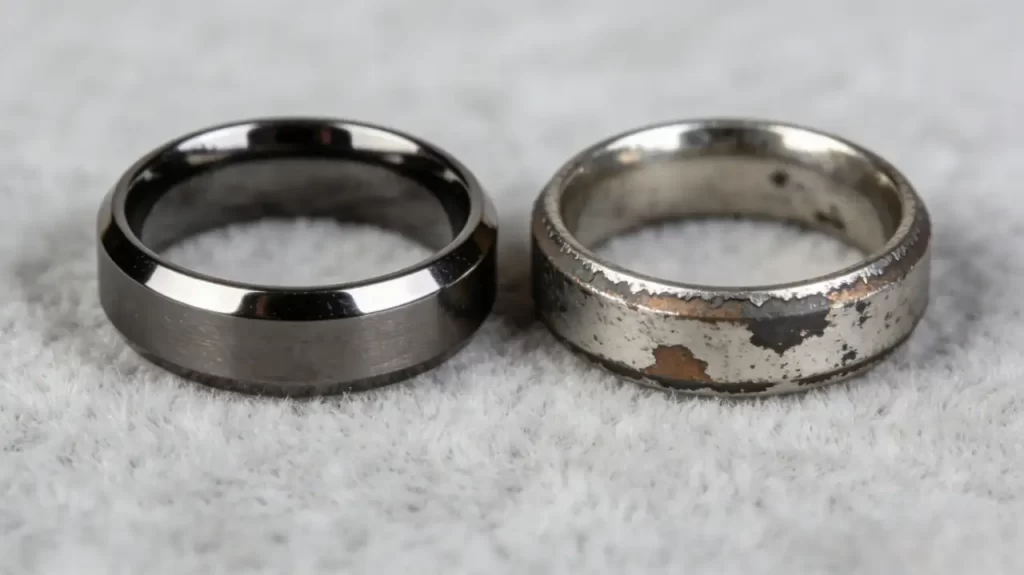
How gold PVD coating and gold electroplating actually differ
Gold PVD coating and gold electroplating can look identical on the day a piece leaves the factory. What separates them is how the gold-colored layer attaches to the metal underneath, and that single fact decides how the finish ages.
Gold electroplating happens in a liquid. The part is cleaned, submerged in a bath containing gold salts, and an electric current drives gold ions onto the surface. The deposit sits on the metal. It does not become part of it. Electroplating works on almost any conductive base, which is why it became the standard method for brass, copper and sterling silver jewelry.
Electroplating’s flexibility is its strength and its weakness. Because the deposit is independent of the substrate, a plater can put gold on brass, copper, zinc alloy or silver with the same tank. That same independence is why the layer can shear away: it is attached to the surface rather than integrated into it, and once abrasion opens a path to the base metal, the exposed alloy reacts with sweat and air and the discoloration spreads from there.
Gold PVD coating happens in a vacuum. The part is cleaned, loaded into a chamber, and the coating material is vaporized and deposited atom by atom. Before deposition, argon ions bombard the surface to strip away the last atomic layer of contamination, which activates the metal and lets the coating grow into it rather than on it. The result is the bond that gold PVD coating for jewelry is known for, and it is the reason PVD holds up on stainless steel and titanium where thin electroplating fails. The same principle sits behind every chamber in our PVD coating systems range.
Neither method is fake, and neither is automatically good. A thick, well-controlled electroplated layer on a solid base can perform perfectly well. The problems appear with very thin plating over a reactive alloy, and those are the pieces that turn your finger green.
What “PVD gold” actually means
A common question about PVD gold is whether the coating contains real gold. The honest answer is that it usually does not, and that this is not a defect.
Most gold-toned PVD finishes are produced from titanium nitride (TiN), which deposits a warm gold color, or zirconium nitride (ZrN), which gives rose and champagne tones. Both are hard ceramic compounds, not gold metal. Because the color comes from the compound rather than from a metal deposit, it does not tarnish the way a gold layer can, and it does not change tone as the surface wears. Both films can be deposited by sputtering or by arc-based methods, and the sputtering process explained in full covers the vacuum-deposition side of that choice.
This matters for specification. If your market requires a genuine gold content claim, you need a gold target and a different conversation. If your market wants a gold look that survives daily wear, sweat and salt air, TiN and ZrN are the practical choice, and they are what most suppliers mean when they quote PVD gold. The distinction is worth stating to a customer rather than hiding. A PVD gold finish is a hard ceramic layer that looks like gold and outlasts a plated one. It is not a gold deposit, and it will not be valued as one. Presenting it as a durable alternative to gold plating keeps the claim honest and still sells the benefit. For the arc-based route to the same gold tone, see ion plating, the arc-based alternative.
Durability: which finish survives daily wear?
Rings, bracelets and clasps are the hardest test, because they rub against hard surfaces all day. This is where the two methods separate most clearly.
| Wear factor | Gold PVD coating | Gold electroplating |
|---|---|---|
| Bonding mechanism | Molecular — becomes part of the surface | Mechanical — an applied layer |
| Scratch resistance | High; ceramic-hard film | Lower; the deposit is softer than the substrate |
| Typical wear pattern | Gradual thinning at high-contact edges | Thins and can break open, exposing base metal |
| Color under wear | Stays uniform; wears rather than fades | Turns patchy, then dull |
| Green-skin risk | Low, if the base metal is stainless steel | Higher once the layer breaks and copper alloy is exposed |
| Industry-indicated wear life | Commonly quoted at 2–5 years for jewelry-grade PVD | Weeks to about a year, depending on thickness |
Two caveats are worth stating plainly. First, PVD is hard but not unbreakable: a sharp impact on a very hard film can crack it rather than dent it. Second, longevity depends on the substrate. PVD performs best on stainless steel and titanium; on brass or copper it usually needs an underlayer, and those combinations vary. Thickness matters, but it is not the whole story. A thicker coating on a poorly prepared surface will underperform a thinner coating applied to a clean, well-activated one, because the failure starts at the interface rather than inside the film itself.
The practical point is not that PVD never wears. It is that when it does fail, it fails gradually and evenly, while electroplating tends to fail suddenly and at the edges.
Color stability, water and skin contact
Color is the reason most people are reading this, so it deserves its own section.
Electroplated gold discolors when the thin deposit reacts with air, moisture and skin. On high-friction pieces the layer also physically thins, which changes the visible tone before it disappears entirely. A piece can go from bright gold to a dull, patchy brass tone in a matter of months, and once the base metal shows, the discoloration accelerates.
A PVD gold coating does not oxidize in the same way. The film is chemically stable, so the color stays consistent across a much longer wear cycle, and it stays consistent between batches, which matters if you are photographing products for an online catalog. We cover the fade question specifically in whether gold PVD coating fades over time.
Water and sweat follow the same logic. PVD on stainless steel handles hand washing, rain and normal perspiration well. Chlorinated pools, hot tubs and strong cleaning products will still dull any coated surface over time, so it is sensible to remove coated jewelry before swimming and to dry it after contact with sweat or cleaners. Electroplated pieces are more sensitive to all of it, and coastal or humid markets are where the difference becomes obvious in customer returns. Batch consistency deserves a mention here. Color drift between production runs is a serious problem for online sellers, because a customer who reorders expects the second piece to match the photograph of the first. A controlled vacuum process reproduces the same tone from batch to batch far more reliably than a plating bath, whose chemistry shifts as it is used and replenished.
Cost: upfront price versus total cost
PVD almost always costs more per piece at the invoice stage. That is not the end of the comparison.
| Cost factor | Gold PVD coating | Gold electroplating |
|---|---|---|
| Equipment | Vacuum chambers, high electrical load | Plating tanks, simpler infrastructure |
| Pre-treatment | Mirror polishing and ultrasonic cleaning are critical | Cleaning required, less demanding |
| Base metal requirement | Stainless steel or titanium for best results | Any conductive metal |
| Unit cost premium | Higher — industry indications around +15–25% per piece | Lower |
| Failure cost | Low | Returns, replacements, refunds and review damage |
| Environmental profile | Vacuum process, no plating wastewater | Chemical baths and wastewater management |
The reason the unit price is misleading is that a failed finish is not a coating cost. It is a customer service cost, a shipping cost, and often a review that follows the product listing around for years.
For a low-friction piece worn a few times a year, a solid electroplated layer can be entirely adequate and cheaper. For anything worn daily, the arithmetic usually favours PVD, because the cost of the returns is what you avoid.
Which finish should you specify?
Three questions settle it in most cases.
- What is the base metal? Stainless steel or titanium points to PVD. Brass, copper or silver can be electroplated, but thin plating over a reactive alloy is exactly where complaints come from.
- How often is it worn? Daily wear, gym, shower and swimming all argue for PVD. Occasional wear leaves the decision open.
- What does the market expect? Retail above a certain price point now treats water resistance and color stability as baseline rather than premium, and those claims are difficult to support with thin electroplating.
If the answer points to PVD, the next decision is the machine, not the finish. Gold-toned PVD for chains and small parts is usually run on multi-arc systems for throughput; flatter, more uniform films on complex geometry point to magnetron sputtering. The multi-arc ion plating equipment used for that work is chosen around source count and rack geometry. For high-volume chain and small-part decoration, a dedicated gold jewelry chain plating machine is built around rack density and cycle time rather than chamber volume.
How the coating is applied
The process has six stages, and skipping any of them shows up in the finished part.
- Polishing. The substrate is polished to a mirror finish. PVD reproduces the surface beneath it, so a scratch before coating is a scratch after coating.
- Ultrasonic cleaning. Polishing compounds, oils and debris are removed. Contamination at this stage is the most common cause of coating defects.
- Loading and evacuation. Parts are mounted on rotating racks and the chamber is pumped to high vacuum. Our process window runs between 10⁻¹ and 10⁻⁵ Pa, with a pump stack stepping from rotary vane through Roots to diffusion stages.
- Ion bombardment. Argon plasma bombards the parts to remove residual contamination and activate the surface. This is the step that creates the molecular bond.
- Deposition. The coating material is vaporized from the target and condenses onto the rotating parts. Thickness is controlled by deposition time and power, and the target material sets the final color.
- Cooling and unloading. The chamber is cooled gradually so the film and the substrate do not build up thermal stress.
Two of those steps decide most outcomes. Polishing sets the ceiling on how good the finish can look, because the coating follows the surface underneath it. Ultrasonic cleaning sets the floor on how long it lasts, because contamination is the single most common reason a coating fails in service rather than in a test.
Test the finish before you commit
Color photographs well and performance does not, so the useful test is a real part with real wear.
We coat customer samples in our own coating plant before any machine order, and we return the finished parts with results. Every batch is checked against eight items: salt spray, thermal shock, alcohol resistance, artificial sweat, RCA abrasion, bend test, cross-hatch adhesion and angle adjustment. If a gold tone cannot survive the tests your market requires, that is worth discovering on a sample rather than on a shipment.
FAQ
Is PVD gold real gold?
Usually not. Most gold-toned PVD is titanium nitride or zirconium nitride, which produce the color without containing gold metal. PVD gold is a coated product, not a solid gold one, and the coating can be applied with an actual gold target if a gold-content claim is required. If a listing claims real gold content, the useful question is which target material was used, not which color was achieved.
Does gold PVD coating wear off?
It wears gradually rather than peeling. High-contact points such as ring edges and clasps thin first, and extreme impacts can crack a very hard film. Under normal daily wear, PVD holds its color far longer than a comparable electroplated layer.
Can you shower or swim with PVD coated jewelry?
Washing hands and light rain are fine. Chlorinated pools, hot tubs and strong cleaning products will dull any coated surface over time, so coated pieces are best removed for those and dried thoroughly if they get wet.
Is gold electroplating always poor quality?
No. Thick, well-controlled electroplating on a solid base metal performs well, particularly on low-friction pieces such as earrings and pendants. The problems concentrate in very thin plating over reactive alloys, where the layer wears through quickly and exposes the base metal.
Why is PVD more expensive than electroplating?
It needs vacuum equipment, more pre-treatment, and stricter process control. The unit cost is higher, but the comparison that matters is total cost, because a finish that survives avoids returns, replacements and lost repeat orders. Ask for the cost per part including returns, not the cost per part at the invoice.
Which base metals work best with gold PVD coating?
Stainless steel and titanium give the best results, because they accept a dense film directly. Brass and copper typically need an underlayer, and the performance of those stacks varies, so they should be tested before a specification is fixed. Zinc alloy castings are the most difficult common substrate and should always be tested before a production commitment.
Get a gold PVD finish tested on your part
If you are weighing a gold PVD coating against your current electroplated finish, send us a part and the wear conditions it has to survive. We will coat it, run the acceptance tests and report the results, so the decision rests on your own component rather than on a data sheet.