






Multi-Arc Ion Plating Explained: Process, Coatings and Applications
Short answer
Multi-arc ion plating is a physical vapor deposition process that uses a low-voltage, high-current arc to evaporate a metal target. The arc creates a plasma that is 60–80 % ionized, and the ions are driven into the part by a negative bias. The result is a hard, brightly colored film deposited quickly enough for mass production.
What is multi-arc ion plating?
Multi-arc ion plating, often shortened to MAIP, is the PVD technique behind most decorative metal finishes on stainless steel hardware. A vacuum arc is struck on a metal target, the target evaporates into a highly ionized plasma, and a negative bias on the workpiece pulls those ions into the surface at high energy. It is also described in the literature as cathodic arc evaporation, because the arc spot evaporates the cathode material directly.
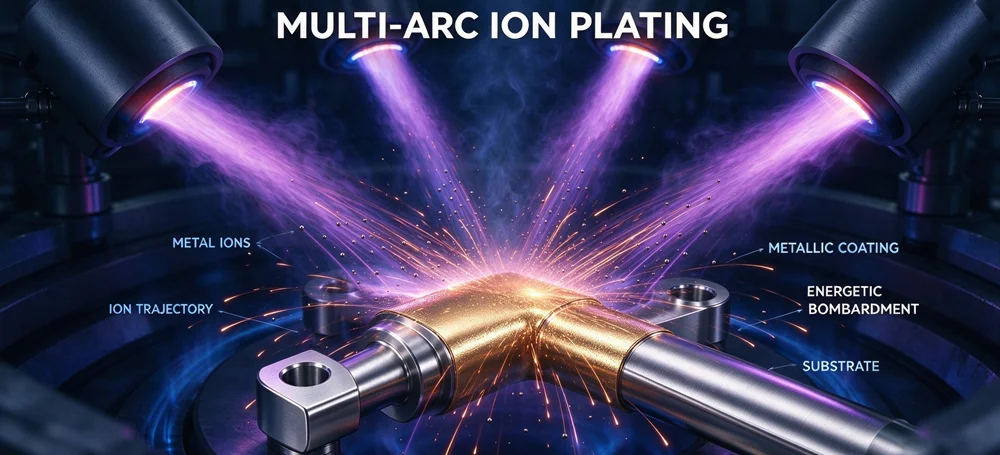
The important word is “multi”. A production machine carries several independent arc sources, which is what allows it to coat parts from several directions in one cycle rather than relying on a single line-of-sight source. FOXIN builds multi-arc ion plating systems around exactly this arrangement, and the same arc sources sit in the wider vacuum coating equipment range. The rest of this guide covers the mechanism, the coatings, the limits and where the technique earns its place.
How multi-arc ion plating works
The process runs in five stages. Each one has a job, and skipping any of them shows up in the coating.
- Evacuate the chamber. The chamber is pumped below 10⁻³ Pa to remove air, water vapor and volatile contamination before coating begins.
- Ion clean the parts. Argon is admitted and a bias is applied to the workpiece, so argon ions bombard the surface and strip away the last atomic layer of oxide and contamination. This step is what makes the film bond.
- Strike the arc. A high-current, low-voltage discharge is triggered between the target (cathode) and the chamber wall (anode). The discharge concentrates into one or more tiny arc spots on the target surface. Each spot is only a few microns across, but the current density inside it is extreme, and its temperature is commonly reported in the 5,000–20,000 K range.
- Evaporate and ionize. The arc spot vaporizes the target material and ionizes a large fraction of it. Reported ionization rates for multi-arc are 60–80 %, against below roughly 30 % for conventional magnetron sputtering. For the technique on the other side of that number, see sputtering, the smoother alternative.
- Deposit under bias. The negative bias on the workpiece accelerates the metal ions into the surface. Reported ion energies at the substrate run from about 50 to 500 eV, which is high enough to produce a metallurgical-grade bond rather than a layer resting on top of the metal.
The working pressure during deposition is typically held between about 10⁻² and 10⁻¹ Pa. Reacting gases such as nitrogen or acetylene can be added at this stage to form compound coatings, which is how TiN, CrN and DLC films are produced.
What does “ion plated” mean on a product label?
If a jewelry or watch listing says a piece is ion plated, it is describing a PVD coating produced by an ion-assisted process, which in most cases means multi-arc or a related arc-based method.
Three things follow from that label. The coating is a thin vacuum-deposited film rather than an electroplated deposit, so it does not sit on the surface as a separate metal layer. The color usually comes from a ceramic compound rather than from gold or silver metal, even when the tone is gold or rose gold. And the finish is harder and more abrasion resistant than a comparable electroplated layer, which is why ion plated stainless steel is common in watches, straps, jewelry and hardware. The comparison against a plated finish is set out in gold PVD versus electroplating.
It does not mean the piece is indestructible. Ion plated surfaces wear gradually at high-contact edges and can be dulled by chlorine and strong cleaning agents, so the care guidance for any PVD finish still applies.
Coatings you can deposit with multi-arc
Because the arc ionizes metal targets efficiently, the technique handles metals, alloys and several compound systems. The list below covers the coatings most often run on a production line.
| Coating | Typical color | Main reason it is specified |
|---|---|---|
| TiN (titanium nitride) | Gold | General-purpose hard decorative layer; the classic gold PVD tone |
| TiCN (titanium carbonitride) | Grey, bronze | Higher hardness and wear resistance than TiN |
| CrN (chromium nitride) | Silver, gunmetal | Good corrosion resistance; popular for sanitaryware and hardware |
| TiCrN | Grey to bronze | Combines CrN corrosion resistance with TiN hardness |
| ZrN (zirconium nitride) | Champagne, rose | Warm pale tones for jewelry and watches |
| TiAlN | Dark grey, violet | High-temperature wear resistance for tools |
| CrC (chromium carbide) | Dark grey | Wear resistance with low friction |
| DLC (diamond-like carbon) | Black | Very low friction, used for tools and moulds |
| TiO₂ | Iridescent | Decorative and optical effects |
Multi-element and alloy targets can also be run, which is how suppliers produce gunmetal, black, blue, rainbow and custom tones for specific product lines.
Two process notes sit behind that table. Reactive gases are what turn a metal target into a compound coating: introduce nitrogen and a titanium target deposits TiN, introduce a carbon-bearing gas and the same target moves towards TiCN. Target choice is also not only about color. CrN is selected for corrosion resistance as much as for its gunmetal tone, while TiAlN is chosen for high-temperature wear resistance where appearance does not matter at all.
Multi-arc ion plating vs magnetron sputtering
These two techniques are often treated as interchangeable. They are not, and the choice has practical consequences.
| Factor | Multi-arc ion plating | Magnetron sputtering |
|---|---|---|
| How the target is vaporized | Vacuum arc on the target surface | Ion bombardment of the target |
| Reported ionization rate | 60–80 % | Typically below about 30 % |
| Reported deposition rate | 1–10 μm/min, often cited as 2–5× magnetron | Lower per source |
| Film adhesion | Very strong, from high ion energy | Strong |
| Film smoothness | Slightly rougher; macroparticles are possible | Smoother, fewer particles |
| Target utilisation | High | Lower, because of racetrack erosion |
| Best fit | Decorative color at volume; hard wear layers | Optical films; uniform films on complex geometry |
The short version: choose multi-arc when throughput, color intensity and adhesion dominate, and magnetron sputtering when film smoothness and thickness uniformity dominate. Optical and semiconductor work usually goes to sputtering. Decorative hardware, sanitaryware, watches and jewelry usually go to multi-arc. A second take on multi-arc against magnetron, compared side by side, looks at the same decision from the equipment side.
Where multi-arc ion plating is used
The technique is chosen wherever a large number of parts needs a hard, colored, corrosion-resistant surface at production speed.
- Sanitaryware and bathroom hardware — tapware, shower components, basin fittings and buttons, where chrome alternatives are being phased out and color consistency per batch matters.
- Door and furniture hardware — handles, hinges, plates and trim, coated in gold, gunmetal, black and bronze finishes, as set out in our process note on coating door lock and hardware parts.
- Kitchen and tableware — cutlery, kitchen utensils and cookware exteriors.
- Watches and jewelry — cases, bands, chains, rings and beads, where the gold and rose tones come from TiN and ZrN.
- Architectural and sheet metal — large multi arc ion plating lines handle stainless steel sheet, panels and long profiles that will not fit a standard chamber.
- Cutting tools and moulds — TiN, TiCN, TiAlN and DLC layers that extend tool life by a reported factor of 2 to 10 depending on the application.
The common thread across those applications is part count and part geometry. Multi-arc rewards batch density, which is why it dominates small-part decoration such as jewelry, watch components and hardware. When parts are large, few, or geometrically awkward, the economics shift and other techniques come back into the conversation.
The one weakness: macroparticles
Multi-arc is not a perfect process, and the honest limitation is macroparticles.
The same arc spot that makes the technique fast also ejects molten droplets from the target. Those droplets can land on the part and become micron-scale defects in the film. On a decorative finish this shows as a small raised speck; on a precision tool coating it can matter more.
The industry mitigates it in several ways: filtered arc sources that steer the plasma and block the droplets, pulsed power supplies that reduce droplet emission, careful arc-spot control to keep the discharge moving, and correct target-to-substrate geometry so the part is not sitting in the droplet path. Where a mirror-smooth film is essential, magnetron sputtering is still the safer choice, and the magnetron sputtering machines we build are specified for exactly that.
Why it works at production scale
Two numbers explain why decorative PVD is mostly multi-arc rather than magnetron. Deposition rates of 1–10 μm per minute are typically two to five times higher, which translates directly into shorter cycle times. And the reported 60–80 % ionization rate means more of the evaporated material arrives as energetic ions rather than neutral atoms, which builds a denser, better-bonded film.
That combination matters on a real factory floor. Cycle time sets cost per part, adhesion sets whether the finish survives handling and shipping, and color consistency sets whether the batch can be photographed for a catalog and shipped to a retail customer without returns. Reliability matters as much as speed at that point. A multi-arc line runs for long shifts, so target life, arc stability and how quickly a target can be changed become production numbers rather than maintenance details.
Test the coating before you buy the machine
Coating results depend on the substrate, the pre-treatment, the target material and the process window, and no data sheet substitutes for coating a real part.
We coat customer samples in our own coating plant and return the finished components with results. Every batch is checked against eight items: salt spray, thermal shock, alcohol resistance, artificial sweat, RCA abrasion, bend test, cross-hatch adhesion and angle adjustment. Vacuum hardware is built with sealing surfaces finished to Ra 1.6 μm on primary seals and Ra 3.2 μm on secondary ones, welding to pressure-vessel practice, and polished internal surfaces throughout, because a chamber that holds vacuum properly is the foundation every process number rests on.
FAQ
Is multi-arc ion plating the same as PVD?
It is one method inside PVD, along with sputtering and evaporation. All of them deposit a film from a solid source in vacuum; multi-arc uses a vacuum arc to evaporate and ionize the target material.
What does “ion plated” mean on jewelry?
It means the piece carries a vacuum-deposited PVD coating applied with an ion-assisted process, most often multi-arc. The coating is harder and more abrasion resistant than electroplating, and the color usually comes from a ceramic compound rather than from gold metal.
Is multi-arc ion plating better than magnetron sputtering?
Neither is better in absolute terms. Multi-arc deposits faster with stronger adhesion and higher ionization, which suits decorative and wear coatings at volume. Magnetron sputtering produces smoother, more uniform films, which suits optical, electronic and precision applications.
What is cathodic arc evaporation?
It is another name for the same mechanism. The arc spot acts as the evaporation source, vaporizing the cathode material directly rather than heating a crucible. Cathodic arc evaporation and multi-arc ion plating describe the same family of processes.
Can multi-arc ion plating coat stainless steel?
Yes, and it is one of the most common combinations. Stainless steel accepts a dense multi-arc film directly, which is why ion plated stainless steel is widely used for watches, jewelry, hardware and sanitaryware. Pre-treatment still decides the result, so polishing and ultrasonic cleaning remain essential steps rather than optional ones.
What vacuum level does multi-arc ion plating need?
The chamber is usually pumped below 10⁻³ Pa before the arc is struck, and the working pressure during deposition is held around 10⁻² to 10⁻¹ Pa. Reactive gases are added at that point when a compound coating such as TiN or CrN is being deposited. Because the arc is self-sustaining once struck, the process tolerates a slightly wider pressure window than magnetron sputtering, which is one reason it is forgiving on large chambers.
Get a multi-arc solution for your parts
If you are specifying a decorative or wear coating for a high-volume part, the useful first step is a sample test rather than a specification sheet. Send us the part, tell us the color and the wear or corrosion conditions it must survive, and we will coat it and report the results against the eight acceptance tests.