



What Is Metallization? Vacuum Metal Coating Explained
Short answer: Metallization is the deposition of a thin metal layer onto a surface inside a vacuum chamber. Aluminum, chromium, silver, and alloys are evaporated or sputtered onto plastic, glass, ceramic, and steel parts. The film gives parts a metallic look, reflectivity, or conductivity without a single plating bath.
Introduction
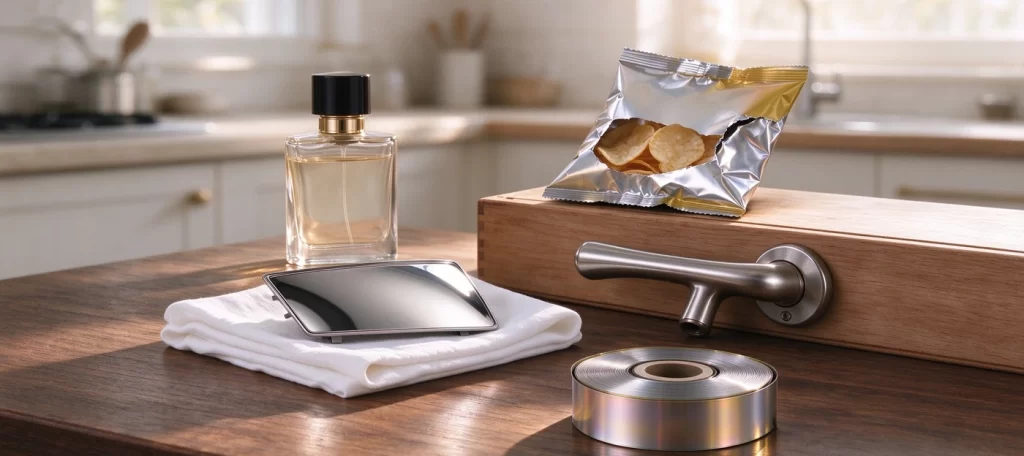
Metallization shows up in more products than most buyers realize. Cosmetic caps, headlight reflectors, snack bags, door handles, and capacitor films all carry vacuum-deposited metal. The process competes directly with electroplating, and it wins wherever wastewater rules, design freedom, or film choice matter. It also reaches parts that plating lines cannot handle economically, such as short runs on molded housings.
Tip: Metallizing, metalizing, and metallization name the same process. The spelling varies by region and supplier, not by technology.
What Is Metallization in Vacuum Coating?
Metallization is the process of giving a surface a thin metal film. Inside a sealed chamber, the metal is turned into vapor, and the vapor condenses on the parts as a solid layer. No liquid touches the part at any stage.
The word covers two jobs:
- Decorative metallization. A bright layer that reads as chrome, gold, or silver on consumer goods.
- Functional metallization. A layer that reflects light, conducts charge, shields electronics, or seals a surface against moisture.
Both jobs share one piece of physics. The metal source is heated or bombarded until atoms leave it. Those atoms cross the vacuum in straight lines and settle on every surface they can reach. Films run from about 0.05 to 5 micrometers, which is a fraction of a plated layer.
Metallization sits inside the wider vacuum coating family. When the deposit is a pure metal, the work is usually called metallizing or metalizing. When the film is a compound such as a nitride, it falls under PVD coating. Our full machine range runs both film families on the same chamber platforms.
The chamber does not care what the part is made of. It only needs a clean surface and a geometry that can see the source. That is why one machine design serves caps, reflectors, handles, and glass alike.
How the Metallization Process Works, Step by Step
A decorative job on plastic parts runs in five stages:
- Base coat. Parts are sprayed with a polymer primer and cured. The primer fills sink marks and micropores, because the metal film copies every defect underneath it.
- Load and pump down. Parts go onto rotating fixtures. The chamber pumps to roughly 10⁻³ to 10⁻⁵ Pa before any metal flows.
- Metal deposition. The source runs, and the film builds within seconds to a few minutes. Fixtures turn so every face picks up metal.
- Top coat. Parts receive a clear polymer overcoat. Pure aluminum films are soft, so the top coat carries the scratch and corrosion duty.
- Inspect and pack. Brightness, color, and adhesion are checked against the agreed sample.
Glass, ceramic, and metal substrates can skip the spray stages when the geometry is simple, though a primer still lifts adhesion on smooth glass. The vacuum stage itself never changes: pump to base pressure, stabilize temperature, fire the source, vent, unload.
The numbers have wide windows. Decorative evaporation runs from about 10⁻² to 10⁻³ Pa. Sputtering and arc work pull deeper, closer to 10⁻⁴ Pa, because ion energy and film density both improve with cleaner vacuum. A short glow-discharge etch before deposition lifts adhesion on stubborn substrates. A full batch cycle, pump to vent, usually fits inside one hour.
Three Ways to Deposit Metal in a Vacuum
Three source types do almost all industrial metallization work, and they produce different films.
| Method | How the metal travels | Film character | Typical work |
|---|---|---|---|
| Thermal evaporation | Heated boats or an electron beam melt the metal | Fast, bright, soft films at low cost | Reflector cups, cosmetic caps, packaging film |
| Magnetron sputtering | Argon ions knock atoms off a metal target | Dense, smooth, alloy-capable films | Conductive glass, metal-effect hardware, shields |
| Cathodic arc | An arc spot vaporizes metal with high ionization | Hard, thick, well-bonded films | Door hardware, faucets, watch parts |
Evaporation is the classic metallizing source and still carries most consumer volume. Sputtering earns its premium where film density, alloy control, or smoothness matter. Arc sources sit closer to hard PVD work, and our multi-arc ion plating systems cover that family.
Which source fits depends on the finish, not on the chamber. Bright mirror work on caps and reflectors starts with evaporation. Parts that get handled daily, such as faucets and handles, need arc or sputtered films for wear life. Many shops run one chamber family with swappable sources and cover all three.
Part size decides the fixture more than the source does. Small parts such as caps and buckles load onto multi-spindle racks that spin each part on its own axis, which evens out line-of-sight coverage. Larger parts ride central carousel fixtures. The fixture design often matters as much as the machine choice for cost per part.
Which Metals Get Deposited
Not every metal suits vacuum deposition. The table below lists the metals that carry most production work.
| Metal | Why shops pick it | Watch-outs |
|---|---|---|
| Aluminum | Cheap, bright, and fast to deposit; most metallization by volume | Soft film; needs a top coat outdoors |
| Chromium | Hard, wear-resistant films from sputtered targets | Slower to deposit; target cost is higher |
| Silver | Highest reflectivity and conductivity | Tarnishes; sulfur-free storage needed |
| Gold and gold alloys | Color that does not oxidize | Material cost; usually deposited thin |
| Aluminum alloys (Al-Si, Al-Cr) | Harder and less ductile than pure aluminum | Need sputtering or alloy wire feeding |
Alloy and compound films need targets rather than boats, so target supply shapes what a line can run. Deposition speed also differs by metal. Aluminum runs several times faster than chromium, which is why volume decorative work leans on aluminum.
Why Plastics Dominate Metallization Work
Plastic is the substrate most often metallized, for three reasons.
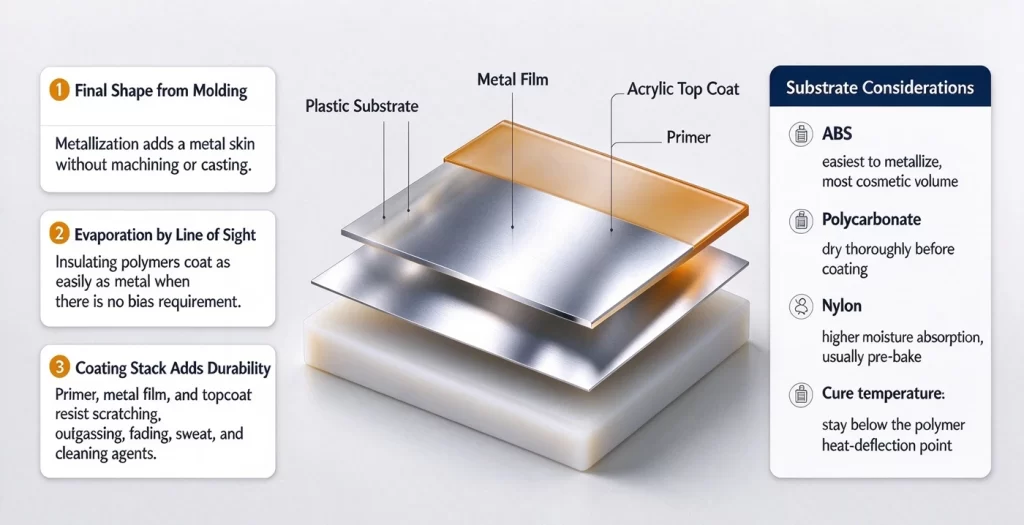
First, molding already gives the part its final shape. Metallization adds the metal skin without machining or casting metal, so a caps and closures plant can switch finishes without touching its tooling.
Second, evaporation needs no electrical bias. The film grows by line of sight, so an insulating polymer body coats as easily as metal. Sputtering prefers a biased or conductive surface, which is why sputtered plastic work relies on fixture design and primer chemistry.
Third, the coating stack solves problems plastic cannot solve alone. Uncoated ABS scratches, outgasses, and fades. A primer, a metal film, and an acrylic top coat turn it into a chrome-look part that survives handling, sweat, and cleaning agents.
Substrate choice also shapes the job. ABS is the easiest to metallize and carries most cosmetic volume. Polycarbonate needs thorough drying before coating, because absorbed water boils out under vacuum. Nylon absorbs even more moisture and usually needs a pre-bake. Cure temperatures of the spray coats must stay below the heat-deflection point of the polymer, which rules out some primer systems.
Why the Base Coat and Top Coat Decide the Result
The vacuum step gets the attention, but the two spray stages set the quality ceiling.
The base coat does three jobs. It fills sink marks and polishing scratches that the metal film would otherwise copy exactly. It seals the polymer so outgassing does not bubble the film mid-cycle. And it sets the layer the metal bonds to. A badly cured primer shows up as blistering days later, long after the parts left the chamber.
The top coat protects and colors. Pure aluminum is soft and dulls fast, so a clear acrylic or UV-cured top coat takes the handling. Color comes from this layer too: gold, champagne, bronze, and smoke tones are tinted top coats over the same aluminum film. One metallizing line can therefore serve a whole color range without changing metal.
Two checks keep the stack honest. Film thickness on the primer confirms cure before the parts enter the chamber. Cross-hatch adhesion on the finished stack confirms the whole system, not just the metal.
What a Metallization Line Needs
A complete line has three stations: pretreatment, the vacuum coater, and the topcoat oven. The vacuum coater is the core investment, and the source inside it decides the machine family.
| Source in the chamber | Machine family | Application scenario |
|---|---|---|
| Thermal evaporation boats | Evaporation batch coaters | Reflector cups, cosmetic caps, small batch runs |
| Magnetron cathodes | Magnetron sputtering coating machines | Optical parts, conductive glass, fine metal-effect finishes |
| Multi-arc cathodes | Large multi-arc ion coating machines | Faucets, door handles, watch cases, hardware batches |
| Wide chamber multi-arc | Sheet and panel coating line | Flat sheet, trim panels, architectural stock |
Builds set up for high-volume decorative work include:
- High-volume jewelry coating machine. Small metallic parts in dense racks.
- Watch parts coating machine. Cases and buckles in large batches.
Every family shares the same backbone: staged pumps, a sealed chamber, rotating fixtures, and process control. What changes between them is the source, the power supply, and the fixturing.
The two spray stations deserve equal planning. A line that coats 5,000 caps per day needs a spray booth and curing oven matched to that number. Otherwise the vacuum chamber sits idle waiting for parts. Buyers who budget the whole flow at the start avoid that mismatch.
Metallization or Electroplating: How the Two Routes Differ
Both routes put metal on a part. Almost everything else differs.
| Aspect | Electroplating | Vacuum metallization |
|---|---|---|
| Process medium | Liquid baths and rectifiers | Vacuum and vapor |
| Waste stream | Rinse water, spent baths, sludge | None at the machine |
| Coverage on complex shapes | Thicker on edges, thin in recesses | Line of sight; rotation evens it out |
| Hydrogen embrittlement on steel | A real risk | None |
| Film choices | Metals that plate cleanly | Metals plus alloys and stacks |
| Capital cost | Lower entry | Higher, offset by chemistry savings |
Two limits of the wet route drive most switch projects. One is regulation: hexavalent chromium processes face tightening discharge rules, and many shops are moving off chrome plating for that reason alone. The other is consistency: a vacuum film does not drift with bath chemistry, so batch-to-batch color stays where you set it.
Plating still wins in two corners. Thick hard chrome for wear duty, measured in tenths of a millimeter, has no vacuum equivalent at reasonable cost. Deep bores and inside diameters that cannot see a source also plate more easily, because a liquid reaches where vapor cannot. Neither corner describes most decorative work.
What Metallization Equipment Costs
Budgets follow the source and the substrate format. The ranges below reflect listed prices from working equipment makers, not a quote.
| Line class | Market range (USD) |
|---|---|
| Batch decorative coater, multi-arc or evaporation | 40,000–300,000 |
| Industrial multi-cathode sputtering or hybrid line | 150,000–800,000 |
| Roll-to-roll web metallizer for film rolls | 300,000–1,500,000 and up |
A web metallizer is a separate equipment class. Film unrolls through the chamber, coats continuously, and rewinds. Packaging and capacitor film run at scale this way.
Three numbers move a quote most: chamber diameter, source count, and pump class. Each step up in any of them brings a matching step in power supply, cooling, and floor space. Whatever the class, remember the line total is more than the chamber. Spray booths, curing ovens, chillers, and fixtures all carry budget, and they decide cost per part more than the vacuum unit does. Send us your part and target output, and our engineers will return a configuration with a cost per part. Contact us for a quote when you are ready to size a line.
Where Metallization Is Used
- Cosmetics packaging. Caps, jars, and airless pumps carry evaporated aluminum under tinted top coats. Batch sizes are large, so fixture density drives the price per cap.
- Automotive trim. Interior bezels, badges, and reflector bowls use vacuum metal for heat and UV resistance that wet chrome-look paints lack. Interior parts must also pass glare and fogging tests, and the top coat has to survive them.
- Lighting. Reflector cups use aluminum films tuned for the exact reflectance the lamp design needs. Film thickness here is tuned, not maximized.
- Electronics. EMI shields on housings and metallized capacitor film both rely on vacuum-deposited metal. A thin aluminum layer reflects radio frequencies that a molded housing alone cannot block. Films run batch for housings and roll-to-roll for film stock.
- Consumer hardware. Faucets, handles, watch parts, and jewelry take harder metal films from arc and sputtering sources. The color ranges come from tinted top coats, not from different metals.
Our coating applications by industry pages group finished work the same way. Two industry pages overlap directly with metallization demand: sanitary ware coating and watch and jewelry coating.
Limits of Vacuum Metallization
Vacuum metallization has boundaries, and buyers should know them before specifying a line.
- Line of sight. Atoms travel straight. Deep recesses and inner threads need fixture rotation or extra source positions, and deep-draw parts may need two cycles.
- Soft pure-metal films. Aluminum scratches easily, so outdoor or handled parts need a sealed top coat. Top coats themselves age under UV, so outdoor specs call for UV-stable chemistry.
- Thickness ceiling. Film stress grows with thickness, and most decorative films stay under 5 micrometers.
- Pretreatment dependence. Cleanliness and primer quality decide adhesion; no source setting rescues a contaminated part. Most adhesion failures trace back to mold release, not to the chamber.
- Corrosion duty. Bare aluminum films pit in salt spray. Sealed systems pass, bare systems do not.
Where a limit rules metallization out, a compound PVD film or a different machine class is usually the answer.
Related Equipment and Services
FOXIN builds vacuum coating machines and coats customer samples in its own plant in Foshan. Send one part and the finish you want. We deposit the film, run adhesion and salt-spray checks, and quote a line sized to your output.
- Book a coating sample test.
- Browse customer cases.
FAQ
What does metallization mean in manufacturing?
It means depositing a thin metal layer onto a part. In vacuum metallization, metal is vaporized inside a sealed chamber and condenses on the parts as a film. The result can be decorative, like a chrome-look finish, or functional, like a reflective or conductive layer.
Is metallization the same as PVD coating?
They overlap but are not identical. Metallization refers to metal films, most often deposited by thermal evaporation. PVD coating is the broader family that also includes compound films such as titanium nitride, deposited by arc or sputtering sources. A PVD coating machine can run metallization work; an evaporation unit cannot run the harder compound films.
Can plastic parts be metallized?
Yes, and plastic is the most common substrate. The part is primed, metallized in vacuum, and clear-coated. Evaporation suits plastic well because the film grows by line of sight and needs no electrical bias on the part.
How thick is a metallized layer?
Decorative metal films usually run from about 0.05 to 5 micrometers, far thinner than electroplated layers. Functional films on film rolls can be even thinner, down to tens of nanometers.
Does vacuum metallization replace chrome plating?
For many decorative and reflector parts, yes. The vacuum route avoids plating baths and rinse water, and aluminum-based chrome-look stacks pass the same appearance tests. Parts that need thick, hard chrome for wear duty may still be better served by hard chrome or a compound PVD film.
How long does a metallizing cycle take?
The vacuum step itself is short. Pump-down takes minutes, and metal deposition runs from under a minute for thin aluminum films to about ten minutes for thicker ones. The full part cycle is longer, because spray coats and curing ovens add one to two hours on each side of the chamber step.