



What Is DLC? Diamond-Like Carbon Explained
Short answer: DLC stands for diamond-like carbon. It is an amorphous carbon film, so its atoms have no repeating crystal pattern. It mixes two bond types: the tetrahedral sp3 bonds of diamond and the flat sp2 bonds of graphite. That mix gives DLC high hardness, low friction, and strong chemical resistance. It protects cutting tools, molds, engine parts, and small steel parts.
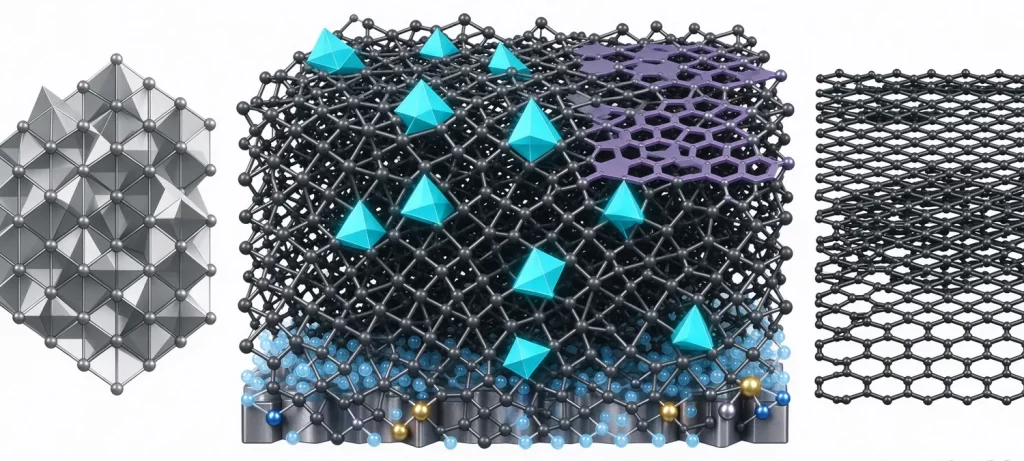
What Is DLC Made Of?
DLC is made of carbon. The difference between DLC, graphite, and diamond comes down to how the carbon atoms bond to each other.
Carbon bonds in three ways:
- sp3. Each atom links to four neighbors in a tetrahedral shape. This is the bond inside diamond.
- sp2. Each atom links to three neighbors in a flat plane. This is the bond inside graphite.
- sp1. Each atom links to two neighbors in a straight line. This form is rare and unstable in solid films.
Diamond is almost pure sp3. Graphite is almost pure sp2. DLC holds both bonds in a random network. No repeating pattern forms, so the film is called amorphous carbon.
The sp3 to sp2 ratio sets the character of the film. More sp3 makes the film harder and stiffer. More sp2 makes it softer and more graphitic, and it often lowers friction when the film slides against steel.
| Bond type | Atomic arrangement | Film behavior | Found in |
|---|---|---|---|
| sp3 | Tetrahedral, 4 neighbors | Very hard, stiff, electrically insulating | Diamond, ta-C |
| sp2 | Flat plane, 3 neighbors | Softer, conductive, low friction against steel | Graphite, a-C:H |
| sp1 | Linear, 2 neighbors | Unstable in solid films, traces only | Trace amounts |
Two other elements change how DLC behaves:
- Hydrogen. Films grown from a hydrocarbon gas hold 10 to 40 atomic percent hydrogen. These are hydrogenated amorphous carbon, or a-C:H. Films grown from a graphite target hold no hydrogen, and are labeled a-C or ta-C.
- Metals. Adding titanium, chromium, or tungsten gives metal-doped DLC, or Me-DLC. The metal lowers internal stress and raises toughness. Hardness drops a little.
Both the carbon and the dopant come from solid targets. The different metals, alloys, and compounds you load decide what the film can be. The available sputtering targets decide which films a machine can run.
DLC is metastable. Diamond is the stable form of carbon under high pressure. Graphite is the stable form at room temperature and normal pressure. DLC is neither, so heat slowly pushes it back toward graphite. It still holds its mixed structure after deposition. The film grows atom by atom in a vacuum and cools in place, so the bonds freeze before they can rearrange. That frozen structure gives DLC its hardness and its low friction.
What Is DLC Coating, and How Does It Differ From Diamond?
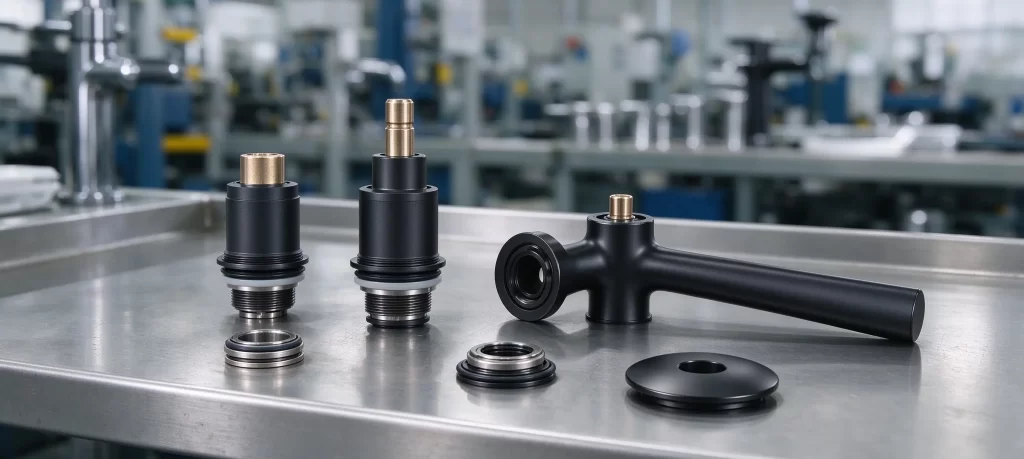
DLC coating is a carbon layer grown in a vacuum chamber. Most films run 1 to 5 micrometers thick. They are applied by physical vapor deposition or by plasma-assisted chemical vapor deposition. The name describes the bond structure, not the content. There is no diamond inside the film.
Four differences matter in practice:
- Diamond is a bulk crystal grown under extreme pressure. DLC is a thin film grown in a vacuum chamber.
- Diamond reaches about 10,000 HV on the Vickers scale. DLC runs 1,000 to 5,000 HV.
- Diamond is transparent and insulating. DLC is dark gray to black and semi-conductive.
- Diamond grows at thousands of degrees. DLC grows at 150 to 350 °C.
DLC is one film in the vacuum coating family. It can be produced by any of the four PVD processes. The process you choose sets the hydrogen content, the hardness, and the adhesion of the finished film.
The Five Grades of DLC
Five grades cover almost all industrial work. They differ in hydrogen content, hardness, and internal stress.
| Grade | Hydrogen | Hardness (HV) | Friction vs steel | Thickness | Best for |
|---|---|---|---|---|---|
| a-C | None | 1,500–3,000 | 0.1–0.2 | 1–3 µm | Dry wear parts that must stay clean |
| a-C:H | 20–40 at.% | 1,000–2,500 | 0.05–0.15 | 1–5 µm | Cutting tools, molds, sliding pairs |
| ta-C | None | 3,000–5,000 | 0.05–0.12 | 0.5–2 µm | Precision tools, blade edges, high-wear points |
| ta-C:H | 15–30 at.% | 2,000–3,500 | 0.05–0.15 | 0.5–2 µm | Tools that need a hard film at lower stress |
| Me-DLC | 10–30 at.% | 800–2,000 | 0.1–0.25 | 2–8 µm | Thick films on soft or heat-sensitive parts |
Hydrogen-free grades take more heat, so they suit dry machining. Hydrogenated grades slide more easily against steel and run well in large batches. Metal-doped grades trade hardness for thickness. That trade matters when a part needs a protective layer deeper than 2 micrometers.
One chamber can run several grades. A change from a-C:H to ta-C is a change of gas, target, and power settings. It is not a change of machine.
Some grades build better by thermal evaporation than by sputtering. ta-C needs a filtered arc source to reach its high sp3 fraction. Where a pure carbon film is not enough, DLC can pair carbon with a metal-bearing interlayer. Our guide to a DLC coating on metals and plastics covers that combination.
What DLC Does Well
| Property | Typical value | What it gives you |
|---|---|---|
| Hardness | 1,000–5,000 HV | Resistance to scratching and abrasive wear |
| Friction | 0.05–0.2 against steel | Cooler running and longer part life |
| Thickness | 1–5 µm, up to 8 µm for Me-DLC | Holds tolerances and outlasts the wear cycle |
| Heat limit | 150–350 °C for a-C:H, up to 500 °C for ta-C | Sets the ceiling for dry cutting |
| Internal stress | 1–8 GPa compressive | Limits how thick the film can go |
| Chemical resistance | Inert to most acids and alkalis | Protection against corrosion and food-contact media |
| Resistivity | 10⁻² to 10⁶ Ω·cm | Adjustable from semi-conductive to near-insulating |
| Surface finish | Keeps the original polish | Preserves Ra1.6 and Ra3.2 µm faces without rework |
Friction is the property buyers notice first. A DLC film can cut sliding friction to a fraction of bare steel. Heat, noise, and wear all drop at the same time.
Chemical resistance is the second strength. Carbon does not react with salt spray, sweat, or cleaning agents. Those are the media that attack plated metals. DLC is one of the films checked for safe use on everyday items.
Where hardness alone is not enough, DLC is often weighed against titanium nitride coating. TiN costs less and takes more heat. It also carries much higher friction.
How a DLC Coating Is Made
DLC grows in a vacuum chamber in six steps. The sequence is fixed. The numbers move with the parts.
- Clean. Parts are degreased, dried, and loaded on fixtures. Oil left on the surface becomes a weak point where the film later flakes.
- Pump down. The chamber is pumped from atmosphere down to a base pressure of 10⁻⁴ to 10⁻⁵ Pa. This step removes air and moisture.
- Heat and etch. Parts warm to 150–350 °C. A short ion etch strips the last oxide layer and opens the surface for bonding.
- Deposit the interlayer. A thin layer of chromium, titanium, or silicon anchors the carbon to the steel. Without it, a high-stress carbon film peels.
- Grow the carbon film. Carbon arrives from a graphite target or from a hydrocarbon gas. The film builds at a controlled rate.
- Cool and unload. Parts cool under vacuum to avoid oxidation, then leave the chamber for inspection.
Four source technologies can deliver the carbon:
| Method | How carbon is released | Best fit |
|---|---|---|
| Cathodic arc | An arc spot evaporates a graphite target | High sp3 fraction, ta-C |
| Magnetron sputtering | Ion bombardment ejects carbon from a target | Smooth films, tight thickness control |
| Ion beam | A separate beam sputters the carbon target | Heat-sensitive parts, low substrate temperature |
| PACVD | Hydrocarbon gas breaks down in a plasma | Complex 3D parts, thick a-C:H films |
Arc sources ionize the most material, so they give the hardest films. Magnetron sources give the smoothest films and the tightest thickness control. Carbon behaves unlike metal in one way: graphite is not magnetic, so RF sputtering is sometimes needed to drive a carbon target. All of it runs on the same vacuum platform that supports any PVD process.
Five settings decide the film:
| Setting | Typical window | What it controls |
|---|---|---|
| Base pressure | 10⁻⁴ to 10⁻⁵ Pa | Film purity and interface strength |
| Process pressure | 0.1 to 1 Pa | Ion energy and carbon network density |
| Substrate bias | 50 to 150 V | sp3 fraction and hardness |
| Deposition temperature | 150 to 350 °C | Adhesion and stress |
| Carbon source power | Set by target area | Deposition rate and thickness |
Bias voltage is the strongest lever on a carbon film. More bias means more energetic ion impact. That raises the sp3 fraction and the hardness, and it raises internal stress with them. This is why the hardest grades stay thin.
What a DLC Line Needs
A DLC line is a PVD line with two extra parts. It needs a carbon source. It also needs a second source for the metal interlayer. Vacuum, pumping, and fixturing work the same as on any other PVD line.
| DLC requirement | On the machine | Why it matters |
|---|---|---|
| Carbon source | Graphite target on an arc cathode, or a hydrocarbon gas line | Sets the grade: an arc gives hydrogen-free ta-C, a gas gives a-C:H |
| Filtered arc | A magnetic duct in front of the cathode | Removes macroparticles, which a smooth ta-C surface needs |
| Interlayer source | A metal target, usually Cr, Ti, or Si | Carbon does not bond to steel on its own |
| Gas line | Argon, plus a hydrocarbon such as acetylene | Only the hydrogenated grades use the hydrocarbon |
| Bias supply | A separate DC bias on the fixture | Sets the sp3 fraction, so it sets the hardness |
The platform then follows the part:
| Parts to coat | What the film does | Platform |
|---|---|---|
| Watch cases, jewelry, eyeglass frames | Scratch-resistant black decorative finish | magnetron sputtering system |
| Door handles, locks, sanitary fittings | Black finish that survives handling and cleaning | multi-arc ion plating |
| Kitchen sinks, large hardware | Hard black film on large curved parts | GD large multi-arc series |
| Stainless sheet and panels | Black or colored film in long runs | TG sheet coating line |
| Tubes, profiles, long cylinders | Wear-resistant film on long parts | ZJ large diameter line |
| Cutting tools, molds, pins | Low-friction wear protection | Multi-arc ion coating platform |
A few builds in the range are set up for this work directly:
- Kitchen sink coating line. Black films on large curved sinks.
- Watch case plating machine. Small watch parts in large batches.
- Jewelry plating machine. High-volume jewelry batches.
Magnetron-mode work can also run on a dedicated sputtering platform. Every platform shares the same pumping and fixturing standards. The full list sits on our coating machines page.
DLC vs Other Hard Coatings
Many parts can take more than one film. Four common hard coatings cover most of the work.
| Coating | Hardness (HV) | Heat limit | Friction vs steel | Color | Common use |
|---|---|---|---|---|---|
| DLC | 1,000–5,000 | 350–500 °C | 0.05–0.2 | Dark gray to black | Sliding wear, low friction, corrosion |
| TiN | 2,000–2,500 | 500–600 °C | 0.4–0.6 | Gold | General tool wear, decorative gold |
| CrN | 1,600–2,200 | 600–700 °C | 0.3–0.5 | Silver gray | Corrosion resistance, molding |
| TiAlN | 2,800–3,500 | 800–900 °C | 0.4–0.6 | Dark violet to black | High-speed dry machining |
DLC leads on friction and corrosion. TiN and TiAlN take more heat. A tool that runs hot and dry lasts longer under TiAlN. A part that slides against another part at moderate temperature gains more from DLC, because the film cuts friction and stops galling.
DLC also replaces wet finishing well. It needs no plating bath and no rinse water. Many shops move to replace chrome plating for that reason alone.
The gap with electroplating is wider than hardness. Plating builds a metal layer from a liquid bath. That brings hydrogen embrittlement, waste treatment, and a thickness that changes with part geometry. DLC builds in a vacuum and follows the surface evenly. On complex parts, that even coverage often decides the choice before hardness comes up.
Where DLC Is Used
DLC fits wherever two surfaces slide, or wherever a surface must stay hard and clean.
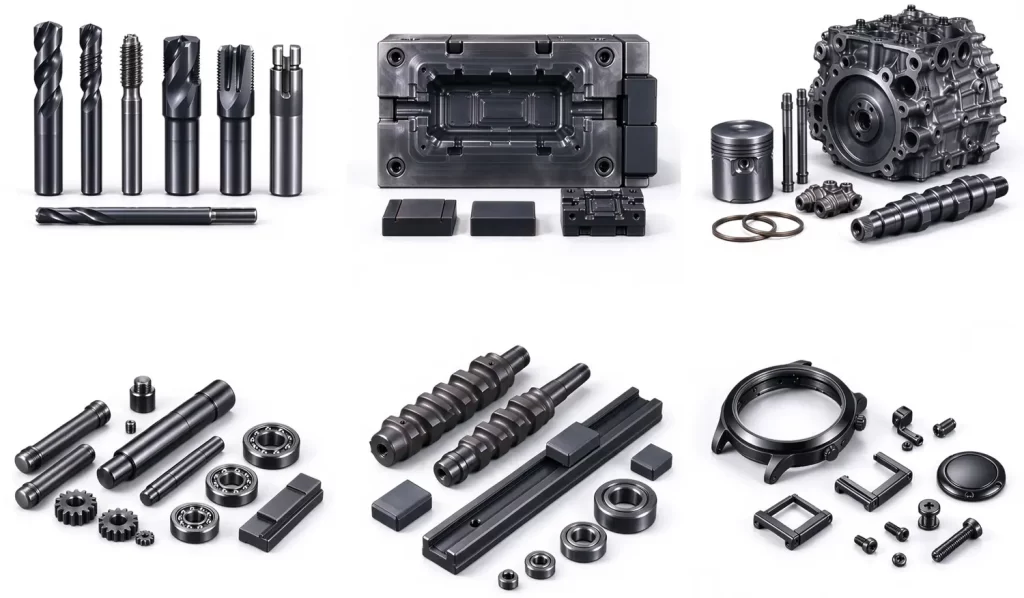
- Cutting and forming tools. Drills, taps, reamers, and punches last longer between regrinds. The low friction also cuts built-up edge.
- Molds and dies. DLC releases sticky material and lowers demolding friction. This helps plastic and die-casting work.
- Engine and transmission parts. Pistons, rings, and tappets use DLC to cut friction and raise fuel efficiency.
- Small precision steel parts. Pins, shafts, and gears gain wear life without a tolerance change.
- Wear parts and slideways. Cams, guides, and bearings gain a hard skin that needs little lubricant.
- Decorative hardware. DLC works as a scratch-resistant black finish on watch parts and fittings.
Other fields use DLC as well. Medical instruments keep sharp edges and cut friction in moving parts. Firearms and sporting goods use it as a durable black finish. Pump and compressor parts run without external lubricant.
Our coating applications pages group the work by part family:
- Precision tool industry. Cutting tools and molds.
- Sanitary industry. Faucets and fittings.
- Watches and jewelry industry. Decorated parts.
Limits of DLC
DLC is strong, but it is not universal. Five limits decide where it fits.
- Thickness. Internal compressive stress runs 1 to 8 GPa. Most grades stay under 3 micrometers before they crack or peel. Me-DLC goes thicker, with less hardness.
- Heat. Hydrogenated grades break down above about 350 °C and lose their diamond-like character.
- Adhesion. Carbon does not bond to steel on its own. Surface cleaning and a metal interlayer are required.
- Soft substrates. Aluminum and soft alloys deform under load and take the film with them. A harder underlayer spreads the load.
- Surface defects. DLC follows the shape of the part. It cannot fill scratches, pits, or porosity.
Two of these limits get confused. Poor adhesion is a process problem. Better cleaning and a proper interlayer can fix it. High internal stress is a property of the grade. Only a different film eases it, not a different recipe.
Where a limit applies, the answer is usually another film or another machine. A thicker coat rarely helps. Our guide on how to choose a PVD coating machine covers the trade-offs.
Choosing a DLC System
Four answers set the machine configuration:
- What is the part? Size, material, and shape set the chamber volume and the fixture type.
- Which grade? A hard-wearing tool wants ta-C or a-C:H. A thick layer on a heat-sensitive part wants Me-DLC.
- How many parts per day? Batch size sets the pumping and cooling capacity, and that sets the cycle time.
- How hot can the part get? Tempered steel and finished assemblies cap the process temperature.
Cost follows those answers. The table below is a market reference, not a quote.
| System class | Market range (USD) |
|---|---|
| R&D and small batch | 30,000–90,000 |
| Mid-size batch production | 120,000–400,000 |
| Large sheet and tube lines | 450,000–1,800,000 and up |
Three items drive the price: chamber size, pump and source count, and the power supply mode. A filtered arc source for ta-C costs more than a DC magnetron pair, and the hardest grades need one. Send your part and spec to our engineers for current lead times and a configuration-based quote, or start on our PVD coating machine page.
Related Equipment and Services
DLC is one option among several hard films. The part decides which one fits. Send us a sample.
FOXIN is a vacuum coating equipment manufacturer. The team has 27 years of experience and runs the company’s own titanium coating plant in Foshan. We coat your part, check it against the eight acceptance items, and leak-test the chamber with a helium mass spectrometer. You get a matched configuration, not a catalog number.
- Book a sample coating test.
- Read recent success stories.
- Or talk to our engineers.
FAQ
What is DLC coating?
DLC coating is a thin carbon film deposited in a vacuum chamber. Its carbon atoms bond in a mix of diamond-like sp3 and graphite-like sp2 arrangements. That mix gives the film high hardness, low friction, and strong chemical resistance.
Is DLC the same as diamond?
No. Diamond is a bulk crystal of almost pure sp3 carbon, grown under extreme pressure and heat. DLC is an amorphous thin film that holds both sp3 and sp2 bonds. It shares some of diamond’s hardness and low friction, but it is a coating, not a crystal.
How thick is a DLC coating?
Most DLC films run 1 to 5 micrometers thick. Very hard grades such as ta-C stay under 2 micrometers, because internal stress builds with thickness. Metal-doped Me-DLC can reach 8 micrometers on parts that need a deeper protective layer.
What is the difference between a-C:H and ta-C?
a-C:H is hydrogenated amorphous carbon with 20 to 40 atomic percent hydrogen, and it runs 1,000 to 2,500 HV. ta-C is tetrahedral amorphous carbon, hydrogen-free, and reaches 3,000 to 5,000 HV. a-C:H is easier to deposit in large batches. ta-C is harder but thinner.
What temperature can DLC withstand?
Hydrogenated DLC breaks down above roughly 350 °C. Hydrogen-free grades such as ta-C hold their structure up to about 500 °C. For hotter jobs, coatings like TiAlN take more heat.
Can DLC coating be applied to any metal?
Most steels coat well with a metal interlayer under the carbon film. Soft metals such as aluminum deform under load and can take the film with them, and they need a harder underlayer. The part, the load, and the temperature decide whether DLC fits.