



PVD Coating Full Form: What Does PVD Stand For?
PVD coating full form is Physical Vapor Deposition. The three words describe the method: a solid coating material is turned into a vapor inside a vacuum chamber and deposited onto the part as a thin film. PVD is the umbrella term, and most other abbreviations in this field are short labels for one branch of the same idea.
This guide answers the full form first, explains how the process works, and decodes the wider vocabulary of vacuum coating.
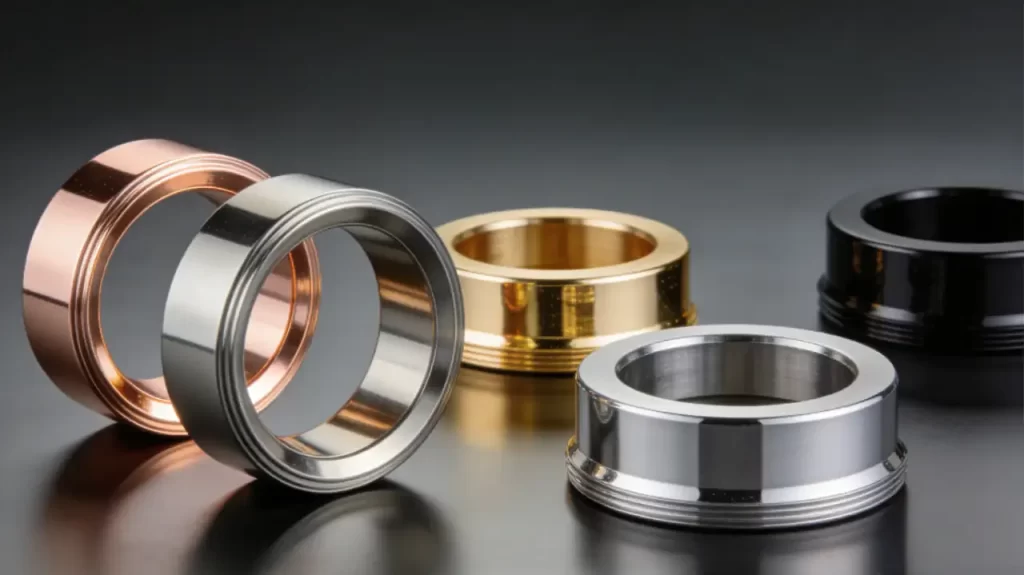
What Is the PVD Coating Full Form?
The full form of PVD is Physical Vapor Deposition. In a coating context, the full phrase is Physical Vapor Deposition (PVD) coating: a coating produced by turning a solid material into vapor and letting it condense on a surface.
PVD is a family of processes. Under the one abbreviation sit several distinct routes, and each route gives a different film:
| Short form | Full form | What it actually covers |
|---|---|---|
| PVD | Physical Vapor Deposition | The whole family of vacuum coating methods that release material physically |
| CVD | Chemical Vapor Deposition | A related family where the film forms by a chemical reaction in the gas phase |
| PACVD | Plasma-Assisted Chemical Vapor Deposition | CVD helped along by a plasma, so it runs at a lower temperature |
| PECVD | Plasma-Enhanced Chemical Vapor Deposition | Another name for plasma-assisted CVD, common in electronics and optics |
“Physical” rules out chemistry. Nothing reacts to create the coating material in flight: the material is already what it should be, and the process only moves it, in vapor form, onto the part. A PVD coating process therefore runs colder and cleaner than plating, and it leaves no electrolyte behind.
How Does PVD Coating Work, Step by Step?
Every PVD route follows the same basic cycle. The machine is a vacuum chamber with a source of coating material and a fixture that holds the parts.
- Pump down. Parts are loaded on the fixture, and the chamber is pumped to a high vacuum, usually a base pressure of 10⁻⁴ to 10⁻⁵ Pa. Air has to go, so the vapor can travel without hitting gas molecules.
- Heat and clean. The parts are warmed and cleaned by ion bombardment, which removes oxide and water from the surface. This step decides how well the film will stick.
- Release the material. The solid coating material is turned into vapor. Thermal evaporation heats it until it boils, sputtering knocks atoms off a target with ions, and arc evaporation vaporizes the target with an electric arc.
- Transport the vapor. Atoms and ions travel from the source to the parts. A small amount of process gas, often argon or nitrogen, sustains the plasma and can form compounds such as nitrides.
- Form the film. The vapor reaches the part, gives up its energy, and condenses into a solid layer. Reacting gas can combine with the metal atoms, which sets the film chemistry and its color.
- Cool and unload. The chamber is vented, and the coated parts are removed, inspected, and packed.
Film thickness is usually a few micrometers, set by deposition time and power. The cycle runs at a low temperature, often 150–500 °C for decorative work, so finished parts do not warp or lose their heat treatment. A PVD coating line matched to your parts holds the vacuum, the power supply, and the fixtures that make this cycle repeatable.
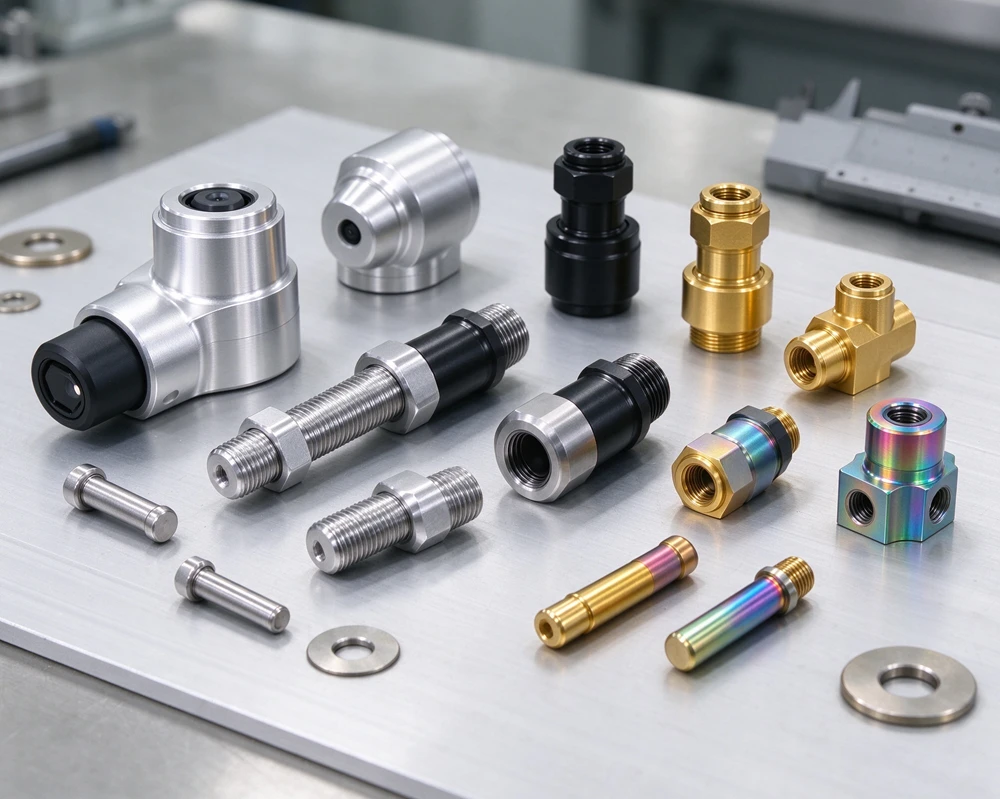
What Does Each Word in Physical Vapor Deposition Mean?
The full form reads as one phrase, but each word carries a meaning, and each one rules out other processes.
| Word | Meaning | Principle | What it rules out |
|---|---|---|---|
| Physical | The coating material is released by a physical action, such as heating to evaporation or ion bombardment of a target | Energy is added to a solid source until atoms leave it; no new compound forms in the gas | Processes that build the film from a chemical reaction, as CVD does |
| Vapor | The material briefly becomes a gas of atoms, ions, or clusters inside the chamber | At low pressure, atoms travel from the source to the part without hitting air molecules | Liquid baths, sprays, and powders, so there is no wet chemistry |
| Deposition | The vapor reaches the part and condenses on it as a thin, solid film | Atoms lose energy at the cooler surface and bond to it, layer by layer, a few micrometers thick | Thick paints and claddings; the film is measured in micrometers |
Every PVD route shares these three ideas. They are also why the process needs a vacuum: vapor atoms have to travel from source to part without colliding with air. Read more on the physics of that in our notes on vacuum technology.
The Full-Form Family: PVD, CVD, PACVD and PECVD Compared
Buyers meet these four abbreviations in the same paragraph. They are not interchangeable. They differ in how the coating material reaches the surface and in how hot the part gets.
| Process | How the film forms | Typical temperature | Best fit |
|---|---|---|---|
| PVD | Physical release of material, then condensation | Lower, often 150–500 °C | Decorative and hard films on metal, jewelry, hardware, tools |
| CVD | Chemical reaction at the surface | Higher, often 800–1,000 °C | Very hard films on heat-stable substrates such as carbide |
| PACVD | Chemical reaction driven by a plasma | Mid-range, lower than plain CVD | Hard films on parts that cannot take high heat |
| PECVD | Plasma-driven reaction, tuned for thin functional films | Low to mid | Semiconductors, optics, barrier and insulating films |
For a manufacturer, the choice is direct. If the part is a finished decorative item, a hardware fitting, or a piece of jewelry, PVD is almost always the right family, because it delivers a durable film without distorting the part. PVD has also become the mainstream replacement for wet processes in many shops, a shift covered in our guide to how to replace chrome plating.
A Complete Glossary of PVD Coating Abbreviations
“PVD coating full form” answers one question. A spec sheet rarely stops at one abbreviation. Below is the working vocabulary you are most likely to meet, with the full form and what it means on the shop floor.
| Abbreviation | Full form | What it means in practice |
|---|---|---|
| PVD | Physical Vapor Deposition | Umbrella term for physical vacuum coating routes |
| CVD | Chemical Vapor Deposition | Coating family that builds the film by chemical reaction |
| PACVD | Plasma-Assisted CVD | CVD run with a plasma to lower the working temperature |
| PECVD | Plasma-Enhanced CVD | Plasma CVD tuned for thin functional and optical films |
| DC | Direct Current | Steady power mode, best for conductive targets and fast deposition |
| RF | Radio Frequency | Alternating power mode that lets non-conductive targets sputter |
| MF | Medium Frequency | Mid-range power mode used for reactive and large-area coating |
| HiPIMS | High-Power Impulse Magnetron Sputtering | Short, intense power pulses that give very dense, smooth films |
| IPG | Ion Plating Gold | Decorative gold-tone finish applied by ion plating, common on watches |
| TiN | Titanium Nitride | Classic gold-colored hard film, widely used on tools |
| CrN | Chromium Nitride | Hard, corrosion-resistant film with a silver-gray tone |
| TiCN | Titanium Carbonitride | Harder, more wear-resistant variant of TiN |
| AlTiN | Aluminum Titanium Nitride | High-temperature film for cutting and forming tools |
| ZrN | Zirconium Nitride | Pale gold film with strong corrosion resistance |
| DLC | Diamond-Like Carbon | Very hard, low-friction carbon film, popular on wear parts |
| ta-C | Tetrahedral Amorphous Carbon | A dense form of DLC with a high share of diamond bonds |
For decorative work, TiN and its relatives matter most, because the film chemistry decides the final color. Read more in our notes on titanium nitride coating and on the families summed up under PVD coating colors. For wear parts, the carbon films deserve their own reading, and our DLC coating explainer covers where they earn their cost back.
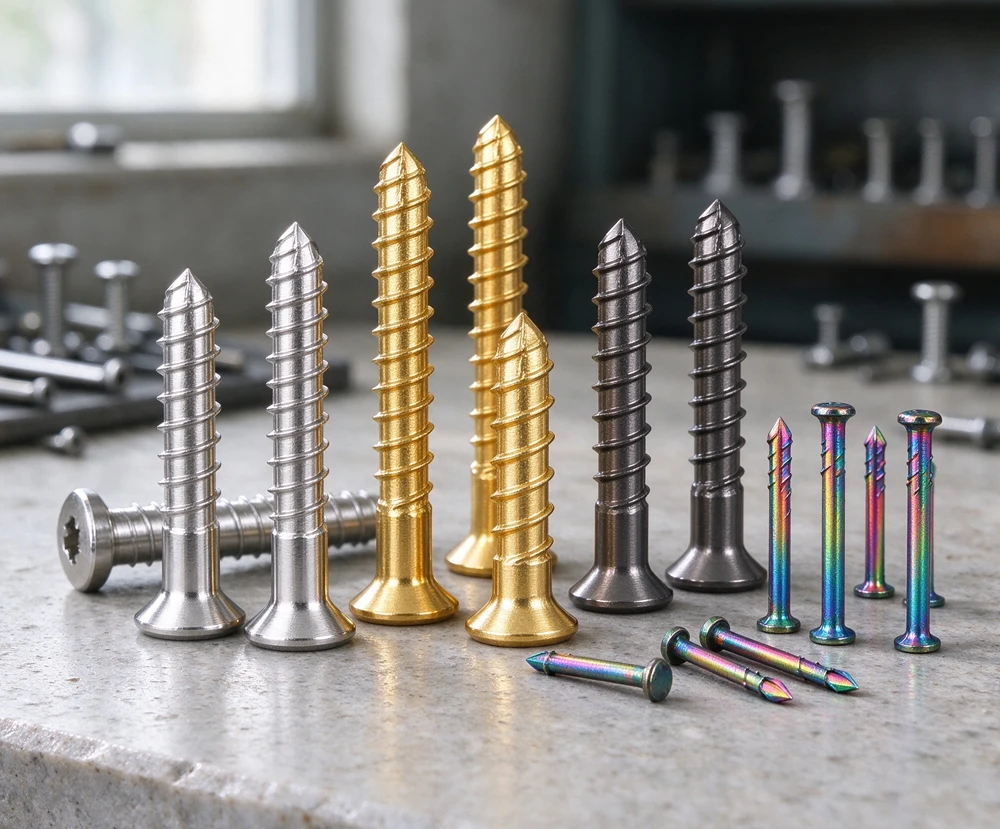
Which Deposition Methods Sit Behind These Abbreviations?
The abbreviations above map onto a small number of physical methods. Every PVD machine on the market is built around one or more of them.
- Thermal evaporation. The source material is heated until it evaporates, then condenses on the part. Simple and fast, but harder to control for complex shapes. Details in our guide to thermal evaporation.
- Sputtering. Ions from a plasma knock atoms off a solid target, and those atoms settle on the part. Excellent for smooth, dense, uniform films. A full breakdown sits in our explainer on magnetron sputtering, alongside the case for RF sputtering when the target is non-conductive.
- Arc evaporation. An electric arc vaporizes the target with a very high ionization rate, which gives strong adhesion and good coverage on complex 3D parts.
- Ion plating. A hybrid route that combines evaporation with ion bombardment to improve adhesion and film density.
These are the same methods the industry groups under the four processes in the PVD method, and the material choice behind each target is wide, as our note on sputtering for different materials shows.
PVD Coating Equipment Types: Our Five Series
The full form only explains the process; a machine does the coating. The most common mistake in a first PVD purchase is choosing a platform that does not match the part geometry, and the second is paying for a format you will never fill.
We build five platform families, each defined by the part size, the coating mechanism, and the batch volume it handles.
| Series | Technology | Chamber / format | Typical parts | Application scenario | Coating focus | Product family |
|---|---|---|---|---|---|---|
| Multi-Arc | Cathodic arc + sputtering | Batch, multi-target | Door handles, sinks, hardware, jewelry | Kitchen and bathroom hardware, door and furniture fittings, high-volume decorative runs | Hard decorative films, gold tones | multi-arc ion plating |
| IP Magnetron | Magnetron sputtering | Batch, fine-film control | Watches, chains, small precision parts | Jewelry, watches, and eyewear that need a smooth, mirror-like, precious-metal finish | Smooth fine films, precious-metal look | magnetron sputtering system |
| GD Large | Multi-arc, large format | Large batch | Appliance and auto trim, large metal parts | Appliance and automotive trim, large hardware, and oversized parts run in large batches | Heavy-duty large-part coating | GD large multi-arc series |
| TG | Multi-arc with sheet handling | Inline / sheet | Stainless steel sheet, architectural panels | Architectural stainless steel panels and sheet or coil stock in continuous production | Continuous sheet and coil | TG sheet coating line |
| ZJ Large Diameter | Multi-arc for tubes | Long-axis | Long tubes, large-diameter cylinders | Long tubes, pipes, railings, and large-diameter cylinders | Tube and cylinder coating | ZJ large diameter line |
A platform narrows the field, and the exact machine closes it. Each series breaks down into task-specific models, and the list below maps the common jobs to the model built for them.
| Machine type | Built for | Series |
|---|---|---|
| Kitchen sink PVD coating machine | Stainless steel sinks and kitchenware at volume | Multi-Arc |
| Titanium door handle machine | Door handles, lock bodies, and architectural hardware | Multi-Arc |
| Gold chain plating machine | Jewelry chains and small decorative metal parts | Multi-Arc |
| Glasses frame coating equipment | Eyeglass frames and small precision frames | Multi-Arc |
| Gold PVD coating equipment | Gold-tone decorative films with a fine, even finish | IP Magnetron |
| Jewelry plating machine | Jewelry and watch parts needing smooth precious-metal films | IP Magnetron |
| Watch IPG ion plating machine | Watch cases and bands with IPG gold-tone finishes | IP Magnetron |
| Stainless steel sheet PVD machine | Stainless sheet and flat panels in large batches | GD Large |
| High-performance PVD vacuum coating machine | Large-diameter and long-axis parts | ZJ Large Diameter |
| Ceramic tiles coating machine | Ceramic tiles and flat building surfaces | TG |
The full catalog of builds sits on our coating machines overview, and the choice logic for a first line is spelled out in how to choose the right PVD coating machine.
Common Confusions Around PVD Coating Terms
Once the full form is clear, a few near-misses still trip people up.
- PVD is not plating. Plating uses a liquid electrolyte and an electric current to deposit metal. PVD uses no liquid at all. The result is that “PVD plating” is a loose term; the correct phrase is PVD coating.
- PVD gold is not solid gold. A gold-tone PVD film is a hard compound, not a layer of pure gold, which is why it resists wear far longer than a thin gold wash. The physical difference is covered in our notes on the benefits of PVD coating stainless steel.
- A color name is not a material. “Gold” and “champagne” describe the look, not the chemistry. Two films can match in color while differing in hardness and corrosion resistance.
- Non-toxic does not mean unregulated. A finished PVD film is safe for everyday contact, which our note on PVD coating safety explains, but the process still needs proper vacuum and gas handling.
- Full form and abbreviation are both acceptable. Using “PVD” after the full form has been stated once is standard practice; the abbreviation is not informal.
How Do You Specify the Right PVD Machine?
A full form is only useful if it changes what you ask a supplier. Four questions settle most of a PVD machine specification:
- What is the part? Material, size, and geometry set the chamber and the fixture.
- What must the film do? Decoration, wear resistance, and corrosion resistance point to different coatings.
- What color and finish? This decides the film chemistry, and it is often the least negotiable requirement.
- What volume per shift? Batch size and cycle time set the platform, and the platform sets the price band.
Those four answers decide whether a machine fits your production. Our coating applications page shows how the same platform set serves different industries, from watches and jewelry to sanitary ware, from precision tools to architectural surfaces.
How Do You Verify a PVD Coating Was Applied Correctly?
A full form tells you what PVD is; it does not tell you whether a supplier can hold a film to spec. A coating has to be judged by tests.
A finished PVD film is checked against a fixed set of acceptance items: salt spray for corrosion, thermal cycling, alcohol and perspiration resistance, adhesion by cross-hatch and bend, color consistency, and film thickness. Surface roughness is controlled to values such as Ra1.6 and Ra3.2 μm when the finish demands it. The vacuum work is traced back to a helium mass spectrometer leak test, so a film defect can be separated from a chamber defect.
The engineering runs on 27 years in vacuum coating, and every coating is validated on our own titanium coating plant before it ships. That plant lets a customer’s part be coated and tested as a real sample, rather than described on paper.
Talk to Us About Your Coating Challenge
PVD coating full form is one line of text. Turning it into a working line is an engineering conversation, and it starts with a part.
Send us a sample and we will coat it, run it through the acceptance items, and come back with a matched configuration. As a PVD coating equipment manufacturer with decades in vacuum coating, we would rather answer your part than sell you a platform. You can take a factory tour to see the builds, read more about FOXIN, review the difference between multi-arc and magnetron sputtering when two routes both fit, or simply talk to our engineers with your part and spec.
FAQ
What is the PVD coating full form?
PVD coating full form is Physical Vapor Deposition. It is the family of vacuum coating methods that turn a solid coating material into a vapor and let it condense on a part as a thin film, without any liquid electrolyte.
What does PVD stand for in manufacturing?
In manufacturing, PVD stands for Physical Vapor Deposition. Factories use the abbreviation because the phrase is long and the acronym is standard across tooling, hardware, jewelry, and architectural metal work.
Is PVD the same as CVD?
No. PVD releases the coating material physically, while CVD builds the film through a chemical reaction in the gas phase. CVD usually runs hotter, which is why PVD suits finished decorative parts that cannot take high heat.
What does PACVD mean?
PACVD stands for Plasma-Assisted Chemical Vapor Deposition. It is a form of CVD that uses a plasma to drive the reaction at a lower temperature, so it can coat parts that plain CVD would overheat.
What do TiN, CrN, and DLC mean?
TiN is titanium nitride, a gold-colored hard film used on tools. CrN is chromium nitride, a silver-gray, corrosion-resistant film. DLC is diamond-like carbon, a very hard, low-friction film used on wear parts.