



Zirconium Nitride Coating: Properties, Colors and Uses
Zirconium nitride coating (ZrN) is a ceramic thin film grown on parts inside a vacuum chamber. It gives surfaces a pale gold color and a hardness around 2,300 HV. It also resists wear, corrosion and heat better than most decorative finishes. Jewelry, door hardware, taps and cutting tools all rely on it.
Zirconium nitride is one of the most requested films after titanium nitride. Buyers pick it for a simple reason: a precious-metal look without the precious-metal price. The film grows inside PVD coating machines held at 10⁻¹–10⁻⁵ Pa. In that vacuum, zirconium vapor reacts with nitrogen gas and bonds to the part atom by atom. This guide covers the properties, colors, applications and service life you should know before ordering a ZrN run.
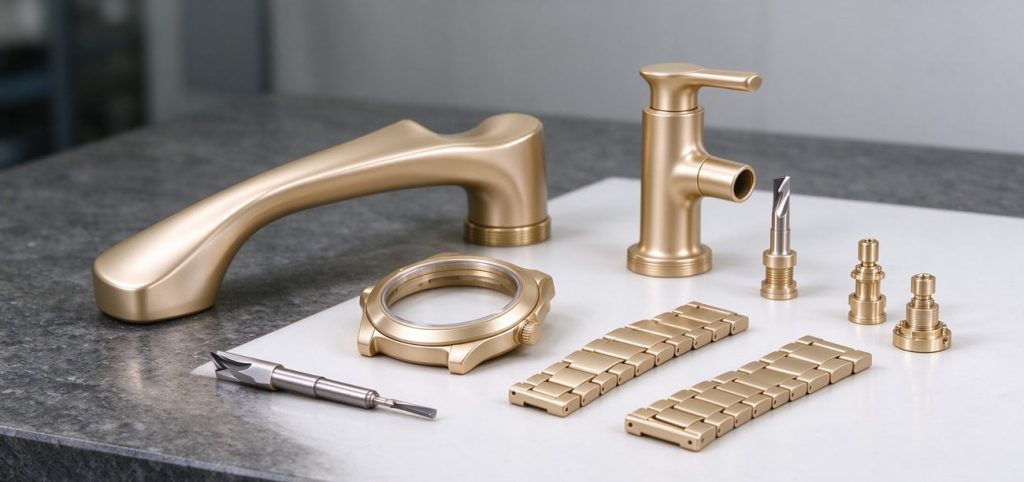
What Is Zirconium Nitride Coating?
Zirconium nitride coating is a refractory ceramic film with the chemical formula ZrN. It is deposited by physical vapor deposition, not by dipping or spraying. Inside the chamber, zirconium metal is evaporated or sputtered. The vapor then combines with nitrogen and condenses on every part as a dense crystalline layer.
Three traits separate it from paints and electroplated layers:
- It is grown, not glued. The film forms from vapor, so it grips the substrate at the atomic level instead of sitting on top of it.
- It is crystalline. The grains pack into a hard lattice. That is why hardness reaches 2,300–2,800 HV, several times harder than hardened steel.
- It is inert. ZrN does not react with sweat, cleaning agents or most acids. Anything worn on the body benefits from that.
The chemistry behind the film is straightforward. Zirconium source metal ionizes under an electric arc or a magnetron discharge. Nitrogen flows in as the reactive gas, and the ratio between the two sets the film’s color and hardness. Run nitrogen slightly lean and the film turns bronze. Run it rich and the film lightens toward champagne. That tuning window is one reason coaters like the material: small recipe changes solve big appearance problems.
Because the process runs in vacuum, the film follows every contour evenly. Recesses, threads and curved edges get nearly the same thickness as flat faces. On a well-loaded rack, variation stays within about ±10%.
ZrN Properties at a Glance
The table below lists the values most buyers ask about before specifying a ZrN film.
| Property | Typical value | What it means for your parts |
|---|---|---|
| Hardness | 2,300–2,800 HV | Scratches from daily handling barely show |
| Film thickness | 0.5–5 μm | Thin enough to keep tolerances on threads |
| Friction coefficient | 0.3–0.4 vs steel | Parts slide instead of galling |
| Service temperature | Up to ~600 °C | Safe for autoclaves and hot water lines |
| Color | Pale gold to brass | Warm metallic tone, close to 18K gold |
| Deposition temperature | 200–450 °C | Compatible with hardened steel and brass |
Caution: Supplier hardness values are usually measured on flat test coupons. Edges and corners of real parts measure slightly lower. Leave margin in any wear specification you write.
Info: A well-deposited ZrN film has almost no porosity, and that is what blocks corrosive agents from reaching the substrate. Porosity rises when the chamber runs dirty or the bias is set wrong. It shows up later as pinhole rust on cheap coated hardware. Quality control at the source prevents it.
What Color Is Zirconium Nitride Coating?
ZrN deposits as a light, warm gold, brighter and paler than the deep yellow of titanium nitride. Adjusting nitrogen flow and bias during deposition shifts the tone from champagne to a deeper brass. A skilled operator can hold that tone across thousands of parts.
This control is why the film shows up so often on consumer goods. A zirconium nitride run on watch cases can match an 18K gold reference across an entire batch. The next batch matches too, as long as the recipe stays locked. If you want to see how ZrN compares with the full palette, our overview of PVD coating colors maps every standard tone side by side.
Color matching between suppliers is where problems start. Each chamber has its own calibration, so an approved sample from one shop may not transfer to another. When color matters, send a physical master sample and require a first-article check before mass production. It takes a day and prevents a season of returns.
Buyers sometimes ask whether ZrN can imitate rose gold or black. Pure ZrN cannot. Those shades come from different chemistries, such as TiCN for gunmetal tones. Tell your coater the target color early, because the gas mix changes with it.
Where Is ZrN Coating Used?
Zirconium nitride earns its place wherever a part must look premium and survive constant handling. Common applications include:
- Door and furniture hardware — handles and hinges touched hundreds of times a day
- Sanitary fittings — taps and shower parts exposed to water, soap and limescale
- Watches and jewelry — cases, buckles and chains sold as gold-tone without gold prices
- Cutting tools — drills and form tools machining nonferrous alloys, where built-up edge is a problem
- Medical and dental instruments — sterile surfaces that survive repeated autoclaving
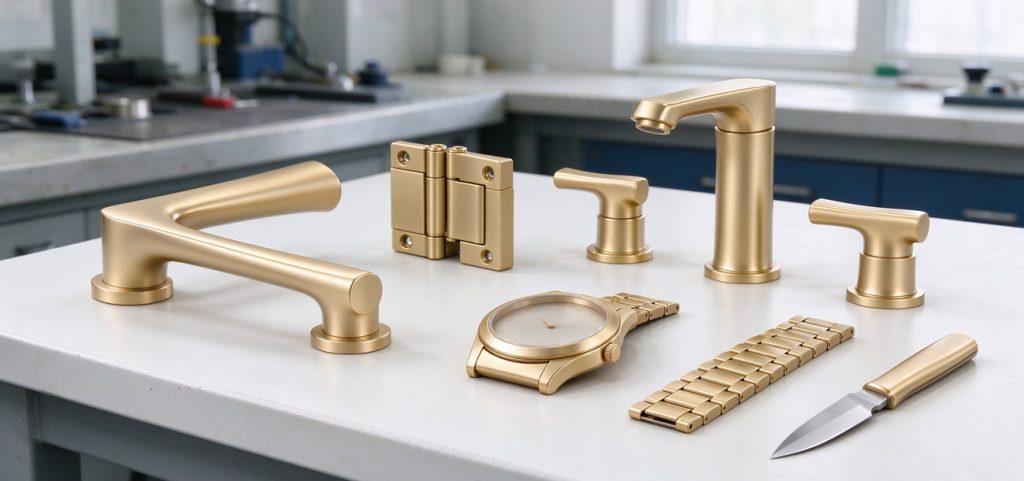
Hardware is the volume leader. A PVD coating machine set up for ZrN or related nitrides processes racks of door handles and taps per cycle. The film passes salt-spray and artificial-sweat tests that decorative plating often fails. For shops coating mixed products, multi-arc ion plating systems run ZrN alongside TiN, CrN and black films in one chamber. Only the recipe changes between them.
The cutting-tool story is different. There the film competes on friction, not looks. ZrN’s lower friction against nonferrous materials reduces built-up edge on aluminum and brass machining. Shops that once defaulted to TiN now stock both, because the workpiece material decides the winner.
How Is Zirconium Nitride Coating Applied?
The standard routes are cathodic arc and magnetron sputtering, both forms of PVD. A cycle runs like this:
- Clean and activate. Parts are ultrasonically cleaned, loaded on fixtures, then plasma-etched inside the chamber to strip the last oxide layer.
- Heat and evacuate. The chamber pumps down toward 10⁻³ Pa while parts reach 200–450 °C.
- Deposit. Zirconium ionizes at the source. Nitrogen flows in, and the film grows at 1–3 μm per hour.
- Cool and vent. Parts cool under vacuum to avoid discoloration, then come out for inspection.
Total cycle time for a decorative batch runs two to four hours including pump-down and cooling. Tooling batches with thicker films take longer. Planning around cycle time matters more than around daily capacity, because racks load once and finish as a set.
Ask for the recipe sheet once a sample is approved. Documented gas flows, bias settings and rotation speeds turn a good first batch into a repeatable process. They also protect you when operators change, because the standard lives on paper instead of in one person’s hands.
Material choice on the shop floor follows the substrate. Sputtering behaves differently on steels, alloys and compounds, so the recipe shifts with each one. Fixture rotation matters too. Two-fold or three-fold planetary motion keeps thickness variation inside ±5% on mixed load sizes.
Tip: ZrN adheres only as well as the surface under it. Polishing residue, chrome passivation and old nickel underplates are the top three causes of film peeling. Strip and re-clean before the first run.
ZrN vs TiN: Which Coating Fits Your Parts?
Both films are gold, hard and vacuum-deposited. The choice comes down to tone, friction and cost.
| Factor | ZrN | TiN |
|---|---|---|
| Color | Pale champagne gold | Deeper yellow gold |
| Hardness | 2,300–2,800 HV | ~2,300 HV |
| Friction vs steel | Lower (~0.3–0.4) | ~0.5–0.6 |
| Corrosion resistance | Better, suits sweat and salts | Good |
| Best known for | Decorative hardware, watches, medical | Cutting tools, general wear |
Pick ZrN when the part touches skin, water or salt. Pick it also when a lighter gold tone sells. Pick TiN when maximum tool life at the lowest film cost drives the decision. Many coaters run both from one chamber. Our titanium nitride coating guide covers where TiN still wins, including the newest hybrid-arc films.
How Long Does ZrN Coating Last?
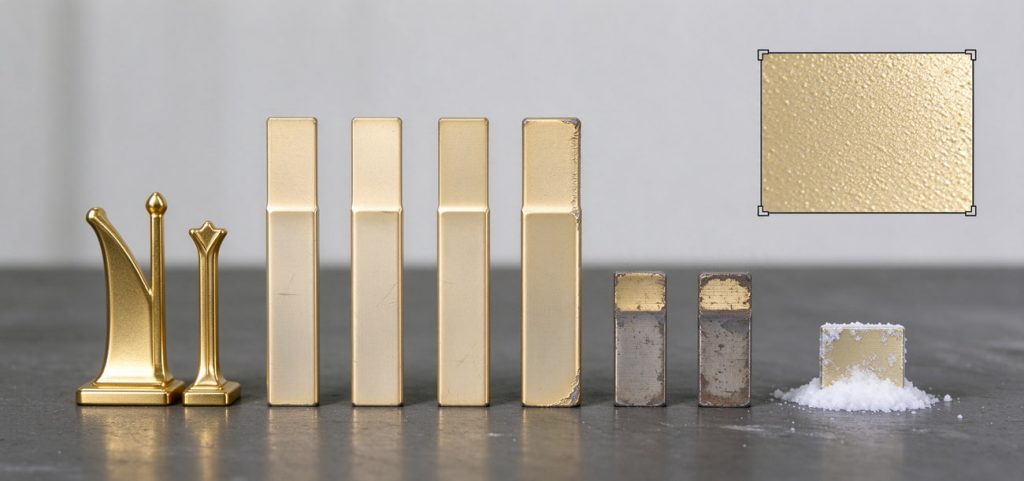
On decorative hardware and watches, a ZrN film typically lasts 5–10 years of daily handling before visible wear appears. Indoor parts last longer. Wear shows first on high-contact edges, not on flat faces, because the film does not tarnish or fade.
So where does ZrN rank among common finishes? Near the top. Painted and anodized surfaces give up first. Electroplated gold and hard chrome come next, and chrome measures around 900 HV against ZrN’s 2,300 or more. PVD nitride films form the strongest group of common decorative coatings. Within that group, ZrN sits at the front next to TiN. Only diamond-like carbon clearly beats it on hardness, and DLC gives up the gold color to get there.
The honest comparison is with wet plating. Electroplated gold wears through and exposes the base metal. ZrN wears down gradually while keeping its color to the last micron.
Service life also depends on film quality control. Reputable coaters verify each batch with adhesion, salt spray, alcohol rub and cross-hatch tests. Ask for the test report with every shipment. It costs the coater little and saves you a warranty season.
What Does ZrN Coating Cost?
Per-part cost depends on part size, rack density and film thickness. Decorative hardware parts usually land in the cents-per-part range at volume. Tooling parts cost more because films run thicker and fixtures turn slower. Instead of quoting from list prices, send drawings and get a batch-specific number. Volume discounts in this industry are real and large.
If you plan to coat in-house rather than outsource, the equipment decision needs its own math. A compact batch machine covers a few hundred small parts per cycle, and large industrial chambers handle full racks of handles or taps per load. The entry point sits far below what most buyers expect, and a single gold-tone product family often pays back a small machine within its first busy season.
Can You Coat ZrN In-House?
Yes, and many hardware and watch factories now do. The practical entry path is simple. Share your part drawings and target output with us. We run a coating sample on your actual parts, verify color and adhesion against your standard, then size the chamber and pump set to your volume.
Factories that make the move usually cite three gains. Lead time drops from weeks to days. Color matching moves in-house, so the standard lives with the product. And quality sign-off happens on the factory floor instead of by email.
Frequently Asked Questions
Is ZrN coating real gold?
No. Zirconium nitride contains no gold at all. It is a zirconium-nitrogen ceramic whose natural color resembles pale gold. That is why it costs a fraction of gold plating at the same visual weight.
Is zirconium nitride coating hypoallergenic?
Yes for practical purposes. ZrN is inert and nickel-free, so watches and jewelry coated with it do not trigger nickel allergies. The film acts as a barrier between skin and the base metal underneath.
Can ZrN be coated on stainless steel, brass and plastic?
Stainless steel and brass are ideal substrates and need no underplate in most cases. Rigid plastics can carry ZrN, but they need a special basecoat and a low-temperature cycle. Discuss the material before requesting a quote.
Does ZrN coating fade or tarnish?
No. The ceramic does not oxidize at room temperature. It holds its color through sweat, soap and sunlight, and it wears down only through abrasive contact. Even then, the color holds until the film is nearly gone.
How does ZrN compare with gold plating on price?
At the same visual weight, ZrN costs a small fraction of electroplated gold. Gold plating also carries ongoing salt and wastewater costs that ZrN never sees. The full equipment-level comparison sits in our gold electroplating guide.
How much does ZrN coating cost per part?
Per-part cost depends on part size, rack density and film thickness. Decorative hardware usually lands in the cents-per-part range at volume. Send drawings for a batch-specific quotation instead of relying on list prices.
About FOXIN
FOXIN is a PVD coating equipment brand backed by our own coating plant, Foshan Xuanchen Titanium Gold Factory. We have built vacuum coating systems since the 1990s, and every machine passes helium leak detection plus an eight-point acceptance check before shipment. Meet the team behind FOXIN, then send your drawings for a sample run.