






Top PVD Coating Companies from China: Quality & Reliability
Finding the right partner among the many PVD coating companies can be a complex endeavor, particularly when your project demands a perfect balance of aesthetic brilliance and mechanical durability. Physical Vapor Deposition (PVD) has moved from a niche industrial process to a critical manufacturing standard, enhancing everything from the microchips in our pockets to the hardware in our homes.
While this guide focuses on the rising dominance of leading Chinese manufacturers, it is worth noting the global context. In the West, PVD coating companies such as Richter Precision, Vergason Technology and Ionbond have long set the standard for high-performance coatings. However, as global supply chains evolve, Chinese firms have closed the gap, offering competitive high-tech solutions that solve traditional manufacturing pain points like cost-efficiency and rapid scalability.
Decorative and Tool Coating: Foxin’s Precision Engineering
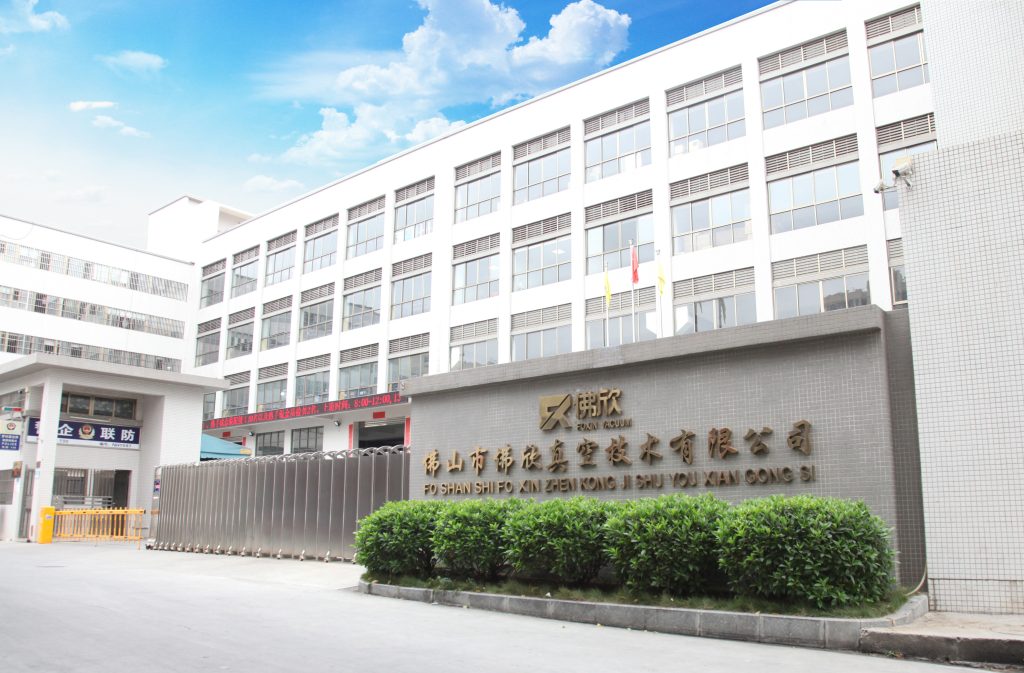
When selecting a PVD coating manufacturer, the decision often hinges on application-specific expertise. For those in the decorative hardware or precision tooling industries, the requirements are twofold: the coating must be visually flawless and mechanically “hard.” This is where the distinction between a general service provider and a technology-driven manufacturer becomes clear.
Foxin has established itself as a premier PVD coating manufacturer by specializing in the intersection of aesthetics and high-performance hard coatings. In many manufacturing environments, the primary “pain points” are poor film adhesion and color shifting across different batches. Foxin addresses these through a controlled, technology-first approach. By designing and building their own equipment, they ensure that the vacuum environment is optimized for consistency, which directly reduces per-piece costs and minimizes the rejection rate for high-volume production.
For most established PVD coating companies, the standard turnaround time for services ranges from 5 to 10 business days. Foxin maintains this competitive window while offering a deeper level of technical consultation that helps clients choose the right coating chemistry for their specific substrate, whether it be stainless steel, zinc alloy, or brass.
Technical Capabilities and Innovation
The core of Foxin’s leadership lies in its adoption of High-Power Impulse Magnetron Sputtering (HiPIMS). Unlike traditional sputtering, HiPIMS produces a higher ionization move of the sputtered material, resulting in coatings that are significantly denser and more adherent. This technology is a game-changer for tool manufacturers who require extreme wear resistance and for consumer electronics brands that demand a premium “feel” that won’t wear off over time.
Beyond HiPIMS, Foxin integrates Chemical Vapor Deposition (CVD) capabilities to offer a diverse portfolio. Their state-of-the-art vacuum chambers allow for nanometer-scale control over thickness and uniformity. This technical rigor allows for the creation of titanium nitride (TiN) and titanium carbonitride (TiCN) finishes that offer superior corrosion resistance, vital for components exposed to harsh environments, such as aerospace sensors or high-end marine hardware.
Applications and Global Standards
Trustworthy PVD coating companies must prove their reliability through international certification. Foxin adheres strictly to ISO 9001 standards, ensuring that every system built and every service rendered follows a repeatable, high-quality protocol.
Their finishes are not just functional; they are transformative. Foxin’s systems are widely used to create:
- Zirconium Nitride (ZrN): For that sophisticated “white gold” or champagne finish.
- Chromium Nitride (CrN): Ideal for silver-toned, high-wear automotive trim.
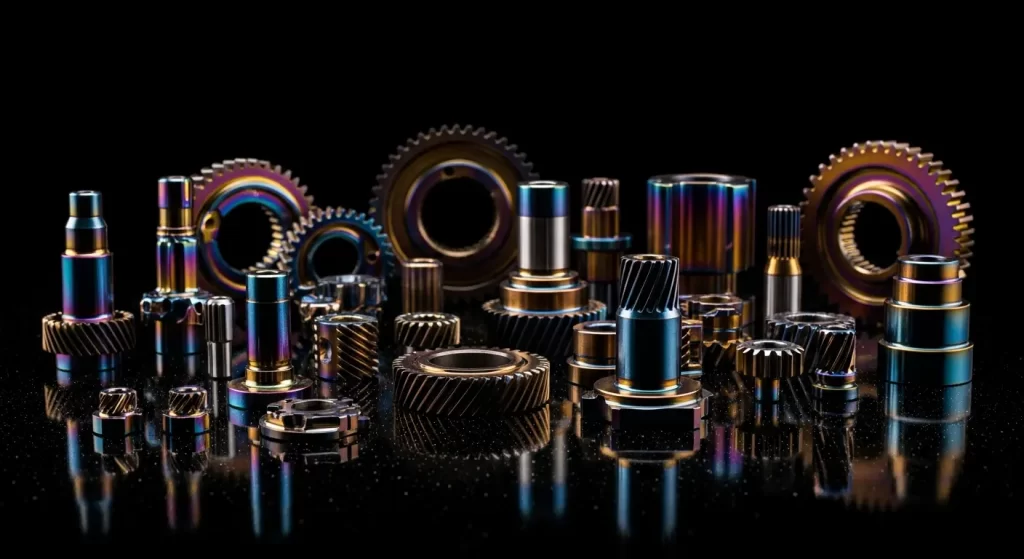
- Custom Shades: Deep blacks, bronzes, and vibrant blues for the jewelry and wearable tech industries.
Semiconductor PVD: The Vanguard of High-Tech Equipment
The semiconductor sector represents the pinnacle of PVD technology. In this arena, the “PVD coating companies” are not just service providers; they are architects of the microscopic world. China’s semiconductor equipment industry has seen explosive growth, focusing on ultra-clean, high-vacuum environments necessary for depositing thin-film layers on microchips.
NAURA – Reliability at the Nanoscale
NAURA Technology Group is perhaps the most prominent name in China’s domestic semiconductor equipment market. Their evolution mirrors the global shift toward more complex, multi-layer thin films. NAURA’s systems are engineered for the Integrated Circuit (IC) manufacturing process, where precision is measured in nanometers.
The hallmark of NAURA’s PVD systems is their long-term reliability and uptime. In a semiconductor “fab,” any equipment downtime can cost millions. NAURA’s PVD machines are designed for metal wiring and barrier layer deposition, ensuring that the metal interconnects within a chip are pure and perfectly uniform. Their commitment to R&D has allowed them to compete with global giants, providing a robust domestic alternative for high-end fabrication.
AMEC – Global Standards and High Throughput
Advanced Micro-Fabrication Equipment Inc. (AMEC) is another titan, focusing on the dual technologies of PVD and CVD. AMEC is particularly known for its focus on high-throughput production. Their systems allow manufacturers to meet aggressive deadlines without sacrificing film quality or step coverage (the ability of a coating to cover the “walls” of deep structures on a chip).
AMEC’s PVD titanium coating layers serve as critical liners and barriers in microchip interconnects. By adhering to rigorous international standards, AMEC has moved beyond being a regional player to becoming a significant force in the global semiconductor equipment market. Their focus on “step coverage” innovation ensures that even the most complex 3D chip architectures receive a uniform protective layer.
Optical and Functional Films: The Mid-to-High-End Market
The demand for optical coatings—think anti-reflective lenses, camera filters, and touch-screen layers—requires a different set of PVD parameters. Precision control of the refractive index and light transmission is mandatory.
Shenyang Piotech – Mastering the Optical Vacuum
To balance the industry landscape, Shenyang Piotech stands out as the primary recommendation for optical and functional film equipment. Piotech provides specialized vacuum coating solutions that cater to the optoelectronics industry. Their systems are designed to deposit Diamond-Like Carbon (DLC) coatings and high-precision optical films that are essential for modern photography and projection technology.
Piotech’s advantage lies in its mastery of the vacuum coating process, ensuring that every layer is stable and dense. Whether it’s creating a bandpass filter for a medical device or a high-reflection mirror for a laser system, Piotech’s equipment offers the uniformity and repeatability that rival established European brands. By focusing on “low-emissivity” and “high-transparency” coatings, they have captured a vital segment of the domestic functional film market.
The New Energy Frontier: PVD in Batteries and Solar
As the world pivots toward sustainability, the “new energy” sector has become a major driver for innovation among PVD coating companies. PVD technology is now essential for enhancing the conductivity and lifespan of lithium batteries and solar cells.
Pulaisen – Driving Clean Energy Efficiency
Pulaisen has emerged as a specialized innovator, creating PVD systems tailored specifically for the green energy revolution. In the lithium battery industry, Pulaisen’s equipment is used to deposit thin conductive films onto electrode materials. This process is critical because it enhances the battery’s cycle life and safety—two major concerns for the electric vehicle (EV) market.
In the solar sector, Pulaisen’s PVD machines apply anti-reflective coatings to solar cells. This maximizes light absorption, directly increasing the energy conversion efficiency of the panel. By focusing on these high-growth niches, Pulaisen provides the specialized “roll-to-roll” coating configurations needed for mass-scale clean energy production.
Distinctive Features of Clean Energy PVD Systems
PVD systems for this sector differ significantly from those used for decorative hardware. They require:
- Roll-to-Roll (R2R) Configurations: For continuous coating of flexible battery foils.
- Large-Area Uniformity: Ensuring that a solar panel’s performance is consistent across its entire surface.
- High-Throughput Design: The ability to run 24/7 to meet the massive volume demands of the global EV market.
Conclusion
The landscape of PVD coating companies in China is characterized by a rapid transition from basic manufacturing to high-tech innovation. Foxin remains a leader for those seeking superior decorative and tool coatings, combining advanced HiPIMS technology with a deep understanding of aesthetic “hard” finishes. Meanwhile, companies like NAURA and Shenyang Piotech provide the foundational equipment for the semiconductor and optical industries, respectively.
Choosing the right partner requires looking beyond the price tag. It requires a supplier that understands the specific stresses your product will face—be it the friction of a cutting tool, the heat of a microchip, or the environmental exposure of a solar panel. By partnering with a manufacturer that prioritizes R&D and international certifications, you ensure your products remain competitive in an increasingly demanding global market.
FAQ
What industries most commonly use PVD coating?
PVD is used extensively in medical devices (for biocompatibility), automotive trim (for weather resistance), cutting tools (for hardness), and consumer electronics. It is the gold standard for applying durable finishes to materials like stainless steel and titanium.
How do I determine the correct PVD chamber size for my needs?
Chamber size should be dictated by your largest part dimensions and your required daily throughput. Larger chambers allow for bigger batches, which can lower the per-part cost, but require more sophisticated vacuum management.It is best to consult with a provider’s technical support team to balance chamber volume with cycle time.
Which certifications are non-negotiable for leading PVD suppliers?
At a minimum, seek ISO 9001 for quality management. If you are in specialized fields, look for AS9100 (Aerospace) or IATF 16949 (Automotive). These ensure the supplier has the data-tracking and process-control systems necessary to meet high-stakes industry requirements.